

Bankable BESS Engineering
Percenec Energy delivers fully certified, utility-grade commercial industrial energy storage systems engineered for high commercial returns and long-term operating safety.
Business & ROI FAQ
Financial return models, incentive navigation, and commercial BESS procurement strategies.
Commercial Energy Storage Investment, ROI & Procurement FAQs
Navigating the commercial and industrial (C&I) energy storage landscape requires complete clarity on total system costs, operational expenditure, delivery schedules, and payback models. Explore our tailormade commercial energy solutions designed to optimize operational efficiency.
Percenec Energy delivers transparent cost structures and precise economic modeling to empower corporate decision-makers, facility operators, and EPC partners. Discover how enterprise energy storage systems generate measurable financial returns while substantially reducing facility energy expenses.
Investment Performance Highlights

What is the typical ROI payback period for commercial energy storage systems?
The average return on investment (ROI) payback period for commercial industrial energy storage systems ranges between 3 and 5 years. Financial payback timelines depend on local time-of-use (TOU) electricity tariffs, peak demand penalties, facility load profiles, and available government or utility tax incentives.
Commercial BESS solutions engineered by Percenec Energy deliver accelerated capital recovery through three core financial value streams:
- Time-of-Use (TOU) Tariff Arbitrage: The system automatically charges during low-cost off-peak hours and discharges during high-cost peak rate windows, significantly lowering daily utility expenses.
- Demand Charge Management & Peak Shaving: Advanced EMS algorithms sense sudden power demand spikes and instantly discharge battery power to cap monthly billing peaks, reducing utility demand charges by 30% to 50%.
- Solar Self-Consumption Optimization: Integrating storage with existing rooftop PV systems captures surplus solar energy that would otherwise be curtailed or exported at low rates, powering operations during high-tariff hours.
| Commercial Operation Type | Primary Revenue Driver | Estimated Annual Savings | Typical Payback Horizon |
|---|---|---|---|
| Heavy Industrial Manufacturing | Demand Charge Management & Peak Shaving | $50,000 to $110,000 | 3.1 to 3.9 Years |
| Cold Storage & Logistics Warehousing | Time-of-Use (TOU) Tariff Arbitrage | $65,000 to $130,000 | 3.0 to 3.7 Years |
| Commercial Business Park | Solar PV Integration & Emergency Back-up | $40,000 to $85,000 | 3.8 to 4.7 Years |
With system round-trip efficiency exceeding 90%, operational losses are minimized to maximize net financial yields over a 15+ year operational lifespan.
What is the typical delivery and installation schedule for a Percenec system?
The full procurement, delivery, and installation schedule for commercial energy storage projects is typically completed within 8 to 12 weeks from contract execution to final grid commissioning.
Percenec Energy leverages pre-engineered modular design and factory-integrated deployment of our containerized energy storage systems to minimize field labor, civil engineering delays, and operational interruption.
Facility load profile audit, electrical single-line diagram (SLD) design, foundation pad civil review, and utility interconnection filings.
Precision packing of LFP battery racks, liquid cooling loops, PCS cabinets, multi-stage fire suppression systems, and comprehensive Factory Acceptance Testing (FAT).
Freight logistics to site, crane rigging onto concrete pads, high-voltage cabling hookups, grounding grid connection, and communication bus wiring.
On-site Acceptance Testing (SAT), BMS/EMS communication sync, protection relay calibration, anti-islanding verification, and formal system handover.
Our dedicated engineering project management team coordinates each milestone to ensure smooth execution, regulatory compliance, and on-schedule commercial operation.
What cost components are included when purchasing a commercial BESS?
Purchasing an industrial energy storage system involves a structured capital expenditure divided across core hardware components, intelligent management software, balance of plant integration, and turnkey engineering services.
Percenec Energy maintains full pricing transparency with fully itemized commercial quotes to help procurement leaders evaluate exact cost distributions:
Tier-1 LFP battery cells, liquid cooling thermal control, IP55 outdoor enclosures, and integrated aerosol/gas fire suppression systems.
Bidirectional PCS inverters, isolation transformers, AC/DC switchgear protection, and grid-tied control interfaces.
Proprietary multi-tier Battery Management System, edge Energy Management System hardware controllers, and cloud IoT platform access.
Site surveying, transformer cabling, pad construction, freight transport, safety compliance certifications, and commissioning.
Long-term operational and maintenance (O&M) costs are kept minimal thanks to liquid thermal management that maintains uniform cell temperatures, reducing auxiliary energy usage and extending battery cell lifespans past 15 years.
C&I BESS Technical Specifications & Safety Standards
Engineers, EPC contractors, and facility managers require definitive technical clarity when evaluating commercial and industrial energy storage systems. Percenec Energy pairs Tier-1 LFP battery technology with proprietary BMS and EMS control algorithms to deliver reliable operation, thermal stability, sub-10ms grid transition, and robust microgrid compatibility.

System Architecture Highlights
| Cell Chemistry | Tier 1 LFP (Lithium Iron Phosphate) |
| Thermal Control | Liquid Cooling System (ΔT ≤ 2.5°C) |
| Fire Safety | 3-Level Detection & Gas Deluge Integration |
| Protocols | Modbus TCP/RTU, CAN 2.0, DNP3, IEC 61850 |
| Switch Time | Sub-10ms Seamless Off-Grid Transfer |
Access technical specifications, system architecture references, compliance information, and engineering resources to support BESS project evaluation.
Explore Technical Resources Battery Chemistry and Three-Tier Safety Architecture
Percenec Energy exclusively utilizes premium grade Lithium Iron Phosphate (LFP) cell technology, selected specifically for commercial and industrial energy storage due to its high thermal runaway threshold, extended cycle life, and exceptional chemical stability. LFP chemistry eliminates thermal risks associated with cobalt-based formulations and maintains reliable performance over thousands of continuous duty cycles.
To maintain optimal internal operating conditions, our industrial energy storage cabinets incorporate an advanced liquid cooling thermal management system. By circulating coolant directly across module cold plates, the system restricts cell-to-cell temperature variations to within ΔT ≤ 2.5°C. This uniform thermal distribution prevents localized aging, preserves overall energy capacity, and extends system service life by up to 20 percent compared to traditional forced-air cooling designs.
System safety is enforced through a multi-layered, redundant protection architecture engineered to exceed international commercial safety standards:
- Level 1 — Cell-Level Prevention: Real-time monitoring of cell voltage, temperature, and internal resistance via distributed BMS controllers. Multi-stage gas and smoke sensors detect early off-gassing long before thermal propagation can occur.
- Level 2 — Cabinet-Level Suppression: Integrated gaseous or aerosol fire suppression agents (such as FK-5-1-12) automatically deploy at individual pack and module levels to extinguish isolated electrical anomalies instantly.
- Level 3 — Facility-Level Protection: External dry-pipe water deluge connections, pressure relief burst disks, and deflagration venting panels built in full compliance with NFPA 69, NFPA 855, and UL 9540A testing standards, protecting adjacent property and site personnel.
PV Microgrid and EMS Control Integration
Integrating energy storage with existing industrial photovoltaic arrays, diesel generators, and building energy infrastructure requires versatile software and hardware interfaces for complete solar plus storage deployment. Percenec Energy systems feature a proprietary Energy Management System (EMS) controller capable of direct interfacing with third-party solar inverters, main facility switchgear, and plant automation networks.
Our hardware controllers natively support standard industrial protocols including Modbus TCP, Modbus RTU, SunSpec, CANbus 2.0, DNP3, and IEC 61850. This broad compatibility enables seamless bidirectional data exchange without requiring expensive third-party protocol converters. The BESS can function as a master microgrid controller or operate as a responsive slave unit under plant SCADA orchestration.
- Peak Shaving & Demand Charge Management: EMS algorithms monitor facility utility meters in real time, injecting battery power automatically during heavy equipment start-ups to keep utility demand charges below contractual thresholds.
- Solar Self-Consumption Optimization: Excess solar generation during mid-day hours is diverted directly into battery storage rather than exported at low feed-in tariffs, maximizing localized clean energy utilization.
- Dynamic Load Following: Real-time power balancing between PV generation, site electrical loads, and battery state of charge ensures smooth power delivery under rapidly changing solar irradiance conditions.
Grid-Tied and Off-Grid Switching Performance
For industrial facilities operating sensitive automation equipment, precision manufacturing lines, or data centers, electrical grid sags and utility blackouts cause severe operational disruptions. Percenec Energy systems incorporate an intelligent Static Transfer Switch (STS) and grid-forming Power Conversion System (PCS) to deliver ultra-fast backup power transition.
Upon detection of utility voltage drop or grid frequency instability, the system transitions autonomously from grid-following mode to islanded grid-forming mode in less than 10 milliseconds. This instantaneous transfer ensures critical loads, PLCs, and production machinery continue running without tripping or experiencing phase disruptions.
- Black Start Capability: The system can energize local microgrid buses independently without relying on external utility grid voltage, enabling cold-start functionality for PV arrays and critical facility circuits.
- Grid Support Services: When operating in grid-tied mode, the PCS provides active power regulation, reactive power compensation (VAR support), and dynamic frequency response meeting IEEE 1547 and UL 1741 SA interconnect requirements.
- Seamless Resynchronization: Once utility grid power stabilizes, the EMS automatically synchronizes internal phase angles with the grid before closing the isolation contactor, eliminating voltage transients or inrush currents.
Environmental Resilience and Degradation Management
Commercial energy storage enclosures are frequently installed in challenging outdoor environments, ranging from coastal industrial sites to hot desert installations. Percenec Energy constructs modular battery cabinets rated to NEMA 3R / IP55 standards, featuring anti-corrosion outdoor coatings, dual-sealed door gaskets, and heavy-duty structural thermal insulation.
Integrated dual-circuit HVAC units maintain internal enclosure temperatures within the ideal operating window of 15°C to 25°C even when outdoor ambient temperatures range from -30°C to 55°C (-22°F to 131°F). By pairing precise liquid thermal management with cloud-connected predictive AI analytics, Percenec Energy minimizes annual capacity degradation and maximizes asset ROI over a 15-year operational lifecycle.
C&I Energy Storage O&M, Warranty & Support FAQs
Percenec Energy combines a global service infrastructure with a cloud intelligent O&M platform to protect your battery assets, maximize system uptime, and enforce transparent energy storage warranty commitments across our entire portfolio of products during their operational lifecycle.
Up to 10-year warranty or 6,000 cycles backed by transparent linear capacity retention benchmarks.
Real-time cell-level telemetry with automated AI diagnostics and proactive thermal safety alerts.
Guaranteed remote triage and diagnostic support initiated within two hours of any system anomaly.
Factory-certified technician dispatch backed by strategically located regional spare parts hubs.
What product warranty and capacity degradation guarantees does Percenec Energy provide?
Percenec Energy offers comprehensive energy storage warranty coverage designed specifically for heavy commercial and industrial (C&I) operational profiles. Our standard battery energy storage systems performance warranty guarantees up to 10 years or 6,000 equivalent full charge-discharge cycles when operated under specified thermal and operational parameters.
Our linear performance guarantee caps annual capacity degradation at ≤2.0%, ensuring usable energy output remains at or above 70% by Year 10. Major hardware subsystems—including Power Conversion Systems (PCS), Battery Management Systems (BMS), Energy Management Systems (EMS), liquid thermal units, and automated fire suppression modules—are covered by a 5-year standard warranty, extendable to 10 or 15 years through customizable service agreements.
- Throughput & Cycles: 6,000-cycle performance guarantee with linear capacity retention clauses
- Full Hardware Coverage: Standard 5-year subsystem warranty for PCS, BMS, EMS, and thermal management
- Degradation Limit: Maximum 2.0% annual capacity degradation for predictable long-term ROI
How does the Percenec O&M team perform remote monitoring and predictive fault warnings?
Percenec Energy utilizes a proprietary cloud intelligent O&M platform that communicates continuously with onboard BMS and EMS hardware via end-to-end encrypted protocols. The platform captures real-time data on cell voltage, module temperature, string current, internal impedance, and state-of-charge (SOC) across every individual LFP cell.
Using advanced AI analytics and thermal modeling, our platform identifies minute internal resistance variances and insulation degradation long before operational hazards occur. Automated event classification routes alerts to remote control centers within seconds, allowing automated thermal adjustments or remote engineering intervention for proactive BESS maintenance.
- Granular Telemetry: Cell-level monitoring tracks temperature and voltage in real time
- Predictive AI Analytics: Machine learning algorithms detect cell imbalance prior to system faults
- Remote Optimization: Secure over-the-air (OTA) updates for continuous EMS firmware tuning
How do international projects receive localized technical support and spare parts supply?
To ensure maximum uptime for international enterprise assets, including deployed commercial industrial energy storage systems, Percenec Energy maintains a network of regional service centers and pre-stocked spare parts depots across major global markets. This structure minimizes lead times for critical maintenance components and emergency repairs.
Our strict service level agreements (SLAs) guarantee a 2-hour online engineering diagnosis and an optional 24-hour onsite response plan with certified field engineers. Local warehouses hold critical replacement stock—including PCS modules, BMS controller boards, liquid cooling pumps, and circuit protection devices—providing rapid fulfillment for seamless commercial energy storage support.
- Regional Warehousing: Localized spare parts stock eliminates long international transport delays
- Certified Field Technicians: Factory-trained teams available for rapid onsite interventions
- Guaranteed SLA Times: 2-hour digital response and fast-track field technician dispatch
Full-Lifecycle O&M & Asset Management Framework
Maximizing the return on investment for a commercial energy storage system requires disciplined operational oversight and structured maintenance protocols. Percenec Energy combines robust hardware manufacturing with full-lifecycle support, ensuring your energy storage assets operate at peak safety and efficiency from initial energization through end-of-life recycling.
Onsite pre-energization audits, grid compliance testing, protective relay configuration, and BMS/EMS calibration.
Scheduled inspections, liquid coolant analysis, terminal torque verification, and protective insulation testing.
Ongoing EMS algorithm refinement adapted to local utility rate changes, demand response programs, and peak tariffs.
Environmentally compliant battery removal, module recycling, and second-life cell repurposing logistics.
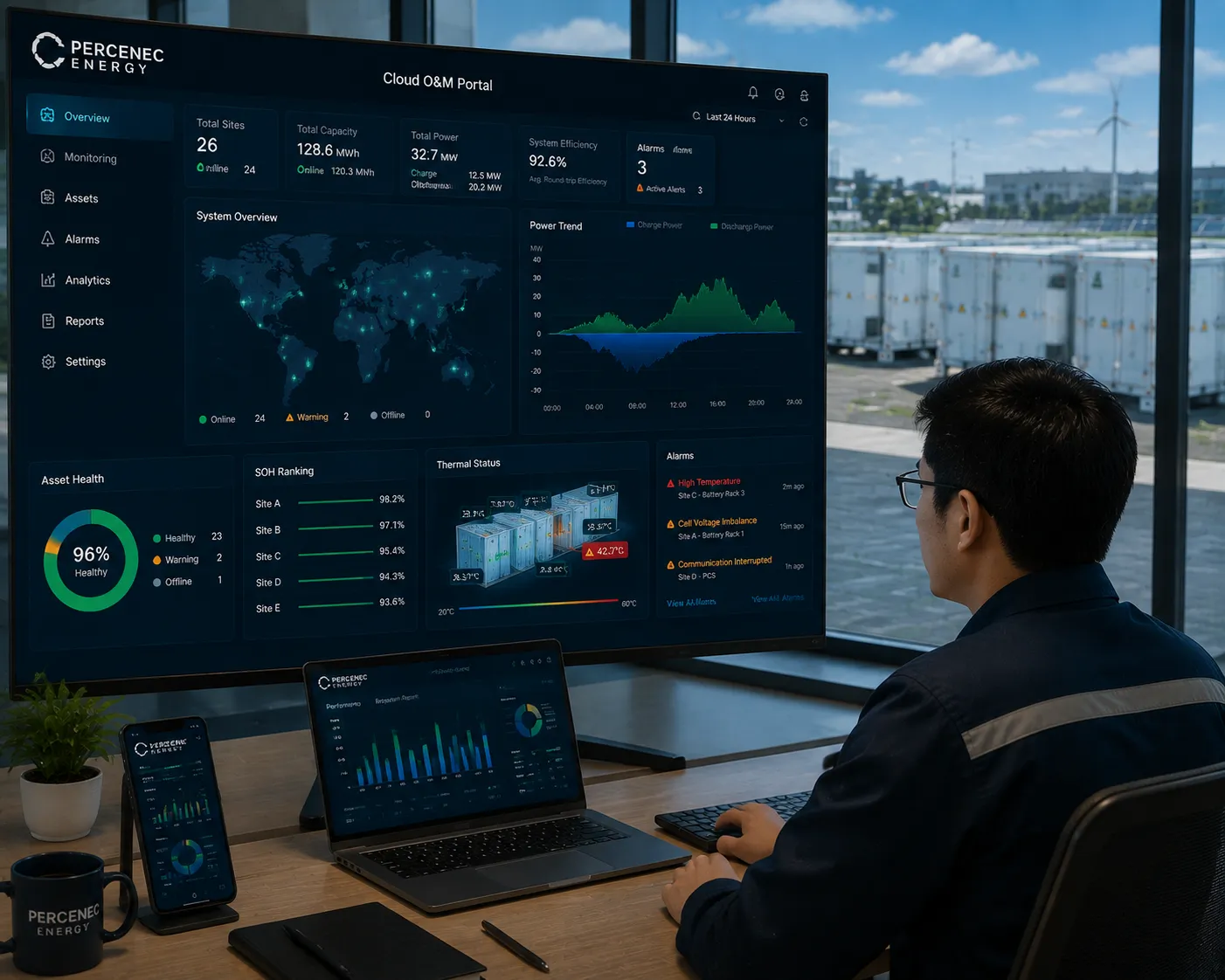
Real-time health telemetry, AI-driven predictive thermal warnings, and automated performance reports.
Percenec Energy Service Level Agreement (SLA) Tiers
Transparent breakdown of support commitments and response timelines
| Support Feature | Standard SLA Plan | Enterprise SLA Plan |
|---|---|---|
| Cloud IoT Data Monitoring | Automated telemetry logging at 15-minute intervals | Real-time high-frequency streaming at 1-second intervals |
| Online Engineering SLA Response | Guaranteed response within 12 hours | Guaranteed priority response within 2 hours |
| Onsite Technical Field Dispatch | Onsite dispatch within 48 business hours | Guaranteed emergency dispatch within 24 hours |
| Spare Parts Supply Chain | Centralized regional depot fulfillment | Dedicated local warehouse reservation & immediate release |
| Preventive Maintenance Inspections | Annual comprehensive system audit | Biannual physical, electrical & thermal system audit |
Need a Custom BESS Solution for Your Facility?
Work with Percenec Energy engineers to evaluate your load profile, optimize battery capacity, and develop a reliable commercial energy storage strategy tailored to your operational requirements.
Technical consultation for peak shaving, solar-plus-storage, microgrid resilience, and industrial energy optimization.