How a Modular BESS Works: Core Architectural Subsystems
When engineering a modern modular battery energy storage system, true system availability depends on decoupling critical failures from total system shutdowns. By dividing power, control, and safety into discrete units, modular architectures deliver plug-and-play scalability with maximum operational uptime.
1. Modular Battery Building Blocks
- Lithium Iron Phosphate (LFP) Standard: LFP chemistry serves as the baseline standard due to its high thermal runaway threshold and proven lifespan exceeding 6,000+ cycles at 80% Depth of Discharge (DoD).
- Voltage Topology Options:
- Low-Voltage (LV) Systems: Optimal for localized commercial applications requiring simplified isolation and lower balance-of-plant costs.
- High-Voltage (HV) Rack Systems: Engineered for high efficiency, reduced cable losses, and direct connection to multi-megawatt grid architectures.
2. Multi-Tiered Battery Management System (BMS)
A 3-tiered BMS hierarchy monitors operating parameters and executes active cell balancing in real time:
- Module-Level BMS: Monitors individual cell voltages and thermal sensors while running active cell balancing algorithms.
- Rack-Level BMS: Aggregates telemetry across modules to compute precision State-of-Charge (SoC) and State-of-Health (SoH) metrics.
- System-Level BMS: Manages master safety loops, controls high-voltage contactors, and interface communications.
3. Distributed Power Conversion Systems (PCS)
- Decentralized Micro-Inverter Topology: Distributes power conversion directly across battery modules or racks. If a single PCS unit faults, the affected module isolates automatically while the rest of the plant operates uninterrupted.
- AC vs. DC Coupling: Supports AC-coupled integration for easy retrofits alongside existing solar arrays, or DC-coupled configurations to maximize round-trip efficiency in direct solar-plus-storage builds.
4. Energy Management System (EMS) & Edge Controllers
The EMS functions as the operational brain, utilizing localized edge controllers for sub-second power dispatch:
- Automated Peak Shaving: Discharges power instantly during demand spikes to eliminate utility penalties.
- Load Shifting & Solar Self-Consumption: Stores low-cost or excess solar generation and dispatches it during peak price windows.
5. Safety and Environmental Controls
- Liquid vs. Forced-Air Cooling: Closed-loop liquid cooling keeps cell-to-cell temperature differentials within ≤ 2°C, significantly reducing degradation compared to forced-air enclosures.
- Fire Isolation & Off-Gas Detection: Multi-point gas detection sensors identify early off-gas emissions (e.g., hydrogen, carbon monoxide) to trigger automated module-level fire isolation before thermal runaway propagates.
Core Architectural Subsystems Overview
| Subsystem | Primary Engineering Components | Operational Impact |
|---|---|---|
| Battery Building Blocks | LFP Cells, LV/HV Racks | 6,000+ cycle life, high thermal stability |
| Multi-Tier BMS | 3-Tier Distributed Architecture | Precision SoC/SoH tracking & active balancing |
| Distributed PCS | String/Micro Inverters | Eliminates single points of failure |
| EMS & Edge Controllers | Dispatch Algorithms & Telemetry | Real-time peak shaving & load management |
| Safety Controls | Liquid Cooling & Off-Gas Detectors | Module-level fire containment & thermal control |
Modular BESS vs. Monolithic Storage Systems
| Technical & Financial Metric | Traditional Monolithic Storage | Modular BESS Architecture |
|---|---|---|
| Initial CAPEX | High: Full projected 10-year capacity purchased upfront | Low: Pay-as-you-grow; sized to immediate baseline demand |
| Expansion Capability | Rigid: Requires isolated secondary units or full system replacement | Seamless: Plug-and-play addition of battery blocks and racks |
| System Redundancy | Single Point Failure: Main breaker/PCS fault drops total output | Distributed: Faulty module isolates without stopping overall plant |
| Maintenance Impact | High Downtime: Complete system shutdown required during repairs | Zero Downtime: Hot-swappable module replacement under live operation |
| Logistics & Footprint | Complex: Heavy cranes required; fixed, rigid footprint | Agile: Forklift-ready cabinets and flexible spatial layouts |
Key Technical Differences
- Capital Expenditure Control: Buying unneeded kWh capacity on day one ties up essential working capital. By deploying scalable battery energy storage systems, you start with a baseline power block and expand in targeted increments as facility demand or solar integration expands.
- Distributed Redundancy: Monolithic architectures present a high single-point-of-failure risk. In a modular configuration, if a single battery module or rack trips, the system automatically isolates that specific unit while the remaining parallel modules continue operating uninterrupted.
- Hot-Swappable Maintenance: Scheduled maintenance on traditional systems often forces complete facility shutdowns. Modular designs feature hot-swappable hardware, allowing field technicians to slide out a faulty pack and drop in a fresh unit without interrupting critical loads.
- Simplified Site Logistics: Giant monolithic enclosures demand specialized transport permits, pad prep, and heavy crane lifts. Modular cabinets and flexible containerized energy storage systems move easily using standard forklifts, fitting cleanly into tight indoor utility rooms or restricted outdoor spaces.
Key Financial & Operational Benefits of Modular BESS
"Pay-As-You-Grow" CAPEX Optimization
- Phased Capital Outlay: Deploy exact baseline requirements today and scale up capacity as facility demand increases.
- Capital Protection: Defer capital expenditures to match real expansion timelines rather than over-budgeting for 10-year projected capacity.
Lowering Levelized Cost of Storage (LCOS)
- Targeted Module Swapping: Isolate and replace individual degraded cells or racks without discarding functioning hardware.
- Extended Asset Longevity: Active cell management maintains higher round-trip efficiency over time, driving down the overall LCOS across the equipment lifecycle.
Continuous Availability & Zero Downtime
- Hot-Swappable Maintenance: Perform servicing or module swaps without shutting down power to the facility.
- Uninterrupted Resilience: Keep critical operations running continuously using scalable energy storage cabinets designed for parallel redundancy.
Multi-Tiered Revenue Stacking
- Diversified Applications: Combine peak demand charge reduction, wholesale energy arbitrage, and frequency response in a single installation.
- Smart Task Distribution: Distribute dynamic dispatch stress across specific sub-modules, preventing premature degradation across the broader system. Deploy dedicated commercial and industrial energy storage systems built specifically for multi-application dispatch profiles.
Financial & Operational Value Matrix
| Operational Dimension | Monolithic BESS Architecture | Modular BESS Architecture |
|---|---|---|
| Initial CAPEX | High (100% capacity funded Day 1) | Low (Sized for current baseline demand) |
| LCOS Control | Full system replacement on degradation | Targeted module replacement lowers lifecycle cost |
| Maintenance Impact | Complete system shutdown required | Hot-swappable zero-downtime maintenance |
| Revenue Stacking | High hardware strain across entire unit | Distributed task allocation preserves battery health |
Primary Applications for Modular Battery Energy Storage Systems
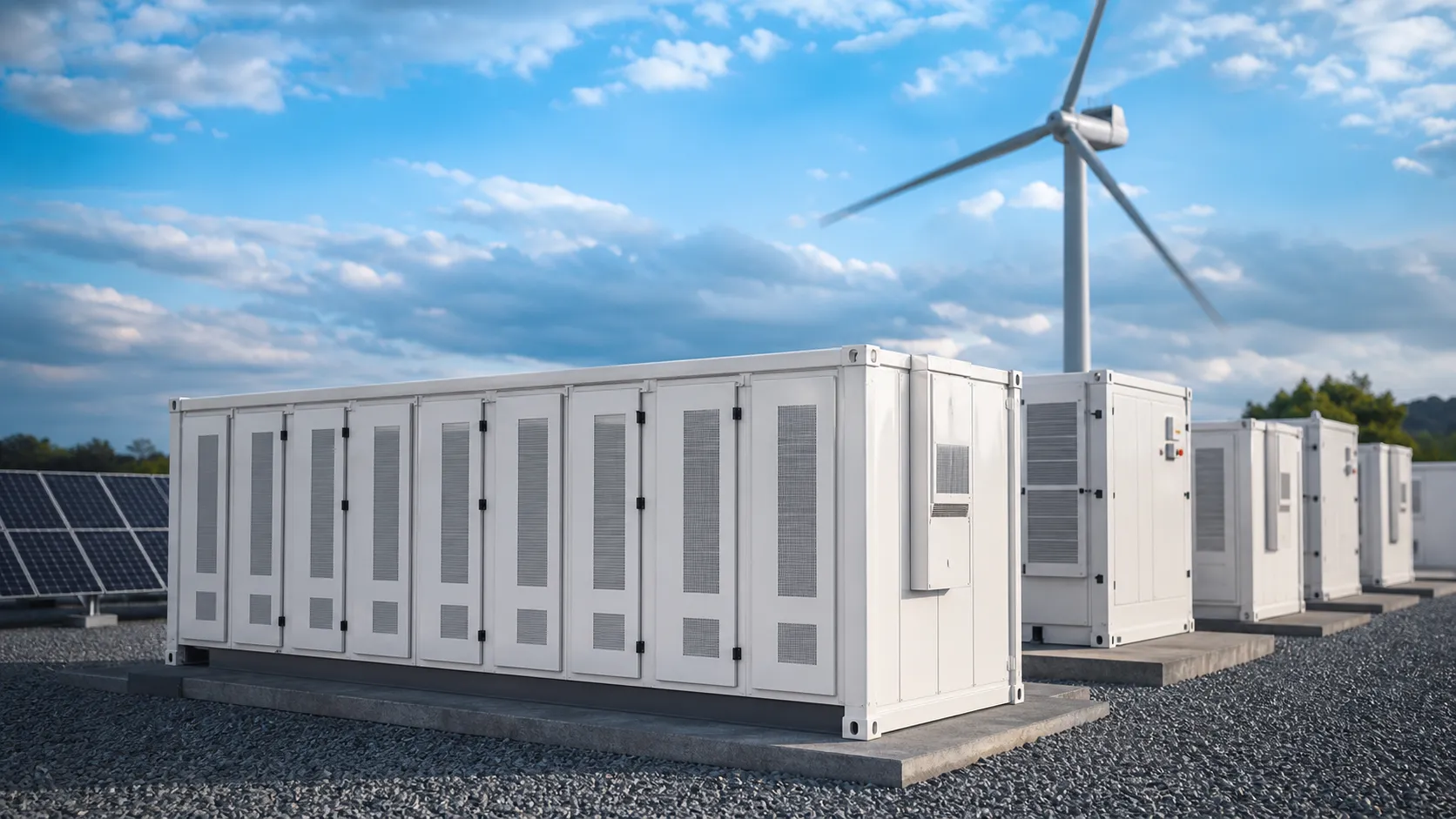
Commercial & Industrial (C&I) Facilities
High electricity bills are frequently driven by peak demand charges rather than total energy use. We deploy modular storage to actively balance intermittent generation and suppress consumption spikes. By combining modular hardware with solar-plus-storage integration, facilities store low-cost clean power during mid-day troughs. Implementing automated peak shaving and load shifting cuts demand penalties while keeping operations fully powered.
EV Fleet Charging Infrastructure
Rapid commercial fleet electrification often outpaces local transformer capacity. Rather than waiting on multi-year utility substation upgrades, we integrate modular storage as a power buffer. The battery system charges gradually during low-demand windows and releases high-kilowatt bursts to DC fast-chargers during peak fleet fueling times, protecting grid assets from overload.
Off-Grid & Hybrid Microgrids
Remote mining, agricultural, and island microgrids rely heavily on expensive, maintenance-intensive diesel generation. Modular microgrid battery integration enables seamless system islanding and dynamic generator displacement. The battery modules absorb sharp load steps, allowing plant managers to throttle back or completely shut off diesel gensets during light-load hours, cutting fuel costs significantly.
Mission-Critical Power Backup
Healthcare centers, data facilities, and advanced manufacturing lines cannot tolerate power sags or outages. Modular architectures offer fast-response uninterruptible power supply (UPS) redundancy. Sub-millisecond transfer speeds protect sensitive equipment during utility dropouts, maintaining continuous operation while secondary diesel generators spin up.
Application Deployment Overview
| Sector | Primary Operational Role | Core Financial & Technical Benefit |
|---|---|---|
| Commercial & Industrial | Demand spike mitigation & PV smoothing | Immediate demand charge reduction |
| EV Fleet Infrastructure | Local transformer capacity buffering | Avoids costly grid interconnection upgrades |
| Hybrid Microgrids | Genset displacement & islanding control | Lower fuel consumption and reduced maintenance |
| Mission-Critical UPS | Ultra-fast emergency power backup | Zero operational downtime for key assets |
Engineering Considerations for Selecting a Modular BESS

When we engineer a modular battery energy storage system. To optimize performance and budget, we focus on three non-negotiable engineering factors: capacity staging, safety compliance, and system interconnection.
Sizing Base Capacity vs. Expansion Margin
- Baseline Load Profiling: Size day-one energy (kWh) and power (kW) specs to meet actual peak demand rather than full 10-year projections.
- Civil & Infrastructure Readiness: Lay out concrete pads, cable trenches, and main switchgear with pre-allocated busbar capacity to accommodate future plug-and-play rack additions without civil rework.
Safety Certifications & Compliance
Operating high-density lithium storage requires total adherence to local and international fire safety standards:
- UL 9540 & UL 9540A: Validates overall system safety and subjects battery packs to rigorous thermal runaway fire propagation testing.
- NFPA 855: Governs installation practices, unit separation distances, and fire mitigation systems.
- IEC 62619: Mandates structural safety requirements for industrial lithium-ion modules.
Review our team's verified quality and safety certifications to inspect full compliance reports, or explore our detailed energy storage buying guide to evaluate deployment requirements.
Interconnection and Grid Compatibility
- Point of Common Coupling (PCC): Verify utility transformer sizing, voltage step-up needs, and short-circuit capability at the grid connection point.
- Control & Protocol Support: Confirm hardware natively supports Modbus TCP, CAN bus, and DNP3 protocols for direct, zero-latency communication with on-site SCADA and energy management software.
| Engineering Factor | Core Requirement | Strategic Value |
|---|---|---|
| Capacity Staging | Target day-one load + expansion footprint | Eliminates over-pumping capital upfront; enables modular expansion |
| Safety Compliance | UL 9540A, NFPA 855, IEC 62619 | Speeds up AHJ permitting and mitigates fire propagation risks |
| Grid Integration | Modbus TCP, CAN, DNP3, PCC sizing | Guarantees seamless communication with existing facility controllers |
Why Choose Percenec Energy Modular Storage Solutions
Engineered for Scalability and Flexibility
We build standardized, stackable enclosures that adapt as your load profile grows. Whether deploying a single outdoor cabinet for commercial peak shaving or scaling out multi-megawatt systems, our custom energy storage solutions scale seamlessly without costly site retrofits or complete equipment overhauls.
Multi-Layer Safety Architecture
Safety is engineered directly into the module architecture to mitigate thermal risks before they escalate:
Cell-Level Diagnostics: Precision monitoring tracks voltage, current, and temperature across every LiFePO4 cell.
Targeted Thermal Distribution: High-efficiency air and liquid cooling maintain uniform operational temperatures across all battery racks.
Active Fire Suppression: Built-in gas detection paired with localized fire suppression prevents thermal runaway propagation.
Smart EMS and Control Intelligence
Hardware efficiency requires intelligent dispatch. Through our advanced BMS and EMS integration, proprietary control algorithms execute real-time telemetry to optimize energy arbitrage, peak demand reduction, and solar self-consumption automatically.
| Architecture Core | Percenec Energy Implementation | Operational Benefit |
|---|---|---|
| System Footprint | Compact, IP54-rated stackable cabinets | Low site pre-work, simple handling, flexible layout |
| Safety System | Multi-tier BMS + integrated fire suppression | Targeted protection; fault isolation without total shutdown |
| Smart Dispatch | Real-time EMS edge algorithms | High LCOS performance & optimized return on investment |
Emerging Trends in Modular Battery Energy Storage System Technologies
The landscape of the modular battery energy storage system is evolving beyond basic rack stacking. In 2026, engineering priorities are shifting toward higher energy density, localized thermal management, and software intelligence built directly into the physical infrastructure.
Here are the key technological shifts reshaping how we design and deploy scalable energy storage solutions today:
High-Density Liquid Cooling
Forced-air cooling is rapidly giving way to compact, module-integrated liquid thermal management.
Thermal Uniformity: Direct cold-plate liquid cooling keeps cell-to-cell temperature variance within 2°C, drastically slowing capacity fade across the entire string.
Footprint Compression: Liquid-cooled packs increase volumetric energy density by up to 30%, allowing higher megawatt-hour capacity within standard outdoor cabinets.
AI-Driven Predictive Maintenance
Modern BMS architecture now streams real-time telemetry to digital twin models running in the cloud.
Pre-Emptive Diagnostics: Algorithms monitor micro-impedance changes and voltage drift to predict module degradation months before an actual performance drop-off occurs.
Targeted Asset Upkeep: Technicians can pre-order and swap specific packs during scheduled windows rather than reacting to sudden operational outages.
Multi-Chemistry Module Compatibility
Standardized enclosures now support hybrid chemistry integration within the same DC bus.
LFP + Sodium-Ion (Na-Ion): Pairing standard lithium iron phosphate (LFP) modules with high-tolerance sodium-ion packs allows assets to operate reliably in sub-zero ambient temperatures without auxiliary heating loads.
Modular Upgradability: Facilities can integrate emerging chemistries as prices drop, future-proofing the cabinet setup against chemical obsolescence.
By combining multi-chemistry flexibility with streamlined project delivery, modern modular systems ensure project developers and facility teams can adapt to grid shifts without over-capitalizing day one.