
Understanding Peak Shaving in Commercial & Industrial Energy Management
What Is Peak Shaving?
Peak shaving is an automated energy management technique where a Battery Energy Storage System (BESS) dynamically discharges power to suppress short-term power spikes. When facility demand approaches critical thresholds during maximum demand intervals, the storage system feeds power directly to your onsite loads. This shields your operation from pulling excess power from the grid, driving immediate demand charge reduction.
Peak Shaving vs. Load Shifting
While often discussed together, peak shaving and load shifting optimize two distinct billing metrics:
| Operational Metric | Peak Shaving | Load Shifting |
|---|---|---|
| Primary Target | kW Mitigation (Peak demand spikes) | kWh Optimization (Bulk consumption) |
| Grid Action | Suppresses short, unpredictable surges | Moves power consumption across time windows |
| Trigger Mechanism | Dynamic, instant response to threshold limits | Scheduled charging based on Time-of-Use (TOU) tariffs |
| Core Value | Eliminates Maximum Import Capacity (MIC) penalties | Capitalizes on electricity price arbitrage |
The Commercial Electricity Bill Structure
To capture the true benefits of peak shaving, you must understand how utilities split C&I energy costs:
Energy Consumption Charges (kWh): The total volume of electricity used across the billing period.
Peak Demand Charges (kW): The maximum power rate drawn during a single 15-minute interval during the month.
The Hidden Cost of Demand Spikes
Modern utility rate structures penalize momentary grid strain. A single 15-minute load spike can account for 30% to 70% of an entire monthly commercial electric bill. Turning on heavy machinery, running HVAC systems at full capacity, or powering EV fast-charging hubs simultaneously creates severe demand surges. We engineer targeted BESS deployments that actively cap these load spikes, protecting your bottom line from unnecessary utility surcharges.
Top 5 Operational & Financial Benefits of Peak Shaving

Benefit 1: Up to 35% Reduction in Peak Demand Charges
Utility companies charge commercial facilities heavy penalties for high short-term energy draw during peak operational windows. Peak demand management mitigates these cost spikes without requiring you to shut down machinery or compromise output.
- Automated Threshold Caps: Intelligent control systems continuously track load demand against set limits.
- MIC Protection: The storage unit automatically discharges when power draw hits designated thresholds, ensuring facility limits are never breached.
- Immediate Cost Relief: Direct suppression of these isolated 15-minute demand peaks leads to up to a 35% drop in monthly demand charges.
Benefit 2: 30%+ Total Energy Bill Savings via TOU Optimization
Energy prices fluctuate significantly throughout the day based on Time-of-Use (TOU) tariffs. By combining peak shaving algorithms with strategic energy arbitrage, businesses unlock substantial operating cost reductions.
By leveraging our advanced peak shaving and load shifting solutions, facilities automatically charge their Battery Energy Storage System (BESS) when grid tariffs are at their lowest off-peak rates. The system then discharges stored electricity during expensive peak price windows, resulting in total electric bill savings exceeding 30%.
Benefit 3: Up to 50% Savings on Infrastructure & Transformer Upgrades
Expanding operational capacity, adding heavy equipment, or installing fast EV chargers often triggers massive utility demand fees for grid connection upgrades.
Peak shaving acts as a localized power booster, allowing facilities to buffer high-load additions within existing grid infrastructure. By using stored battery energy to handle local power surges, companies defer or completely eliminate six-figure utility connection upgrade fees and save up to 50% on capital infrastructure costs.
Benefit 4: Maximizing Onsite Renewable Value (90%+ Solar Self-Consumption)
Commercial solar arrays frequently generate excess energy during mid-day hours when facility demand might not be at its peak. Without local storage, this power is fed back to the grid at low feed-in tariffs—or curtailed entirely.
- Capture Surplus Power: Store 100% of excess solar output generated during low-demand midday windows.
- Offset Evening Peaks: Discharge clean energy during high-tariff evening hours to maximize solar self-consumption rates above 90%.
- Faster Solar ROI: Drastically cut reliance on grid power while accelerating overall system payback.
Benefit 5: Instantaneous Emergency Power Resilience (<10ms Switchover)
Energy storage systems serving peak shaving duties double as critical backup power units.
By integrating engineered microgrid energy storage hardware, facilities maintain standard daily financial optimization while keeping standby power reserves on demand. In the event of an unexpected grid failure, the system delivers sub-10-millisecond (<10ms) switchover speeds—guaranteeing uninterrupted operation for sensitive equipment and critical processes.
Peak Shaving Operational Impact Summary
| Benefit Category | Key Operational Driver | Financial & Technical Impact |
|---|---|---|
| Demand Charge Reduction | Discharges power during max draw intervals | Up to 35% reduction in demand fees |
| TOU Tariff Arbitrage | Charges off-peak, discharges on-peak | 30%+ overall bill savings |
| Infrastructure Deferral | Power boosting for heavy equipment & EV charging | Up to 50% savings on transformer upgrades |
| Solar Self-Consumption | Stores mid-day renewable surplus for peak hours | 90%+ solar utilization rate |
| Uninterrupted Backup | Dual-use standby capacity for outage protection | <10ms switchover speed (zero downtime) |
Financial Metrics & Payback Modeling for Peak Shaving Systems
Calculating the financial returns of peak shaving requires a precise analysis of operational load profiles and local rate structures. By targeting high demand charges, our solutions deliver rapid capital recovery and long-term utility bill savings.
Key Variables Driving Peak Shaving ROI
- Utility Tariff Structures: Higher demand charges ($/kW) and steep Time-of-Use (TOU) rate spreads yield the greatest financial returns.
- Facility Load Profiles: Operations with brief, sharp power spikes achieve maximum cost reduction per kilowatt of installed battery capacity.
- Right-Sized Battery Capacity: Deploying optimized commercial & industrial energy storage systems ensures you mitigate peak demand without over-investing in unnecessary battery capacity.
Achieving Sub-3.5-Year Capital Recovery
For energy-intensive facility operations, a well-engineered battery energy storage system turns volatile power bills into predictable operational savings. By suppressing expensive 15-minute demand spikes and optimizing daily energy usage, facilities across manufacturing, cold storage, and logistics consistently achieve full capital payback in less than 3.5 years.
Comparative ROI Matrix for C&I Applications
| Sector | Primary Load Driver | Core Financial Mechanism | Average Payback Period |
|---|---|---|---|
| Manufacturing Plants | Heavy machinery & motor startup surges | Peak demand charge reduction | 3.0 – 3.5 Years |
| Cold Storage & Logistics | 24/7 continuous refrigeration loads | Demand smoothing & TOU arbitrage | 3.0 – 4.0 Years |
| EV Fast-Charging Hubs | High-kW intermittent charging spikes | Grid capacity buffering & spike capping | 2.5 – 3.5 Years |
| Commercial Real Estate | HVAC system surges & tenant power draw | Demand cap management & emergency backup | 3.5 – 4.5 Years |
Technical Architecture: Hardware & Software Requirements for Effective Peak Shaving
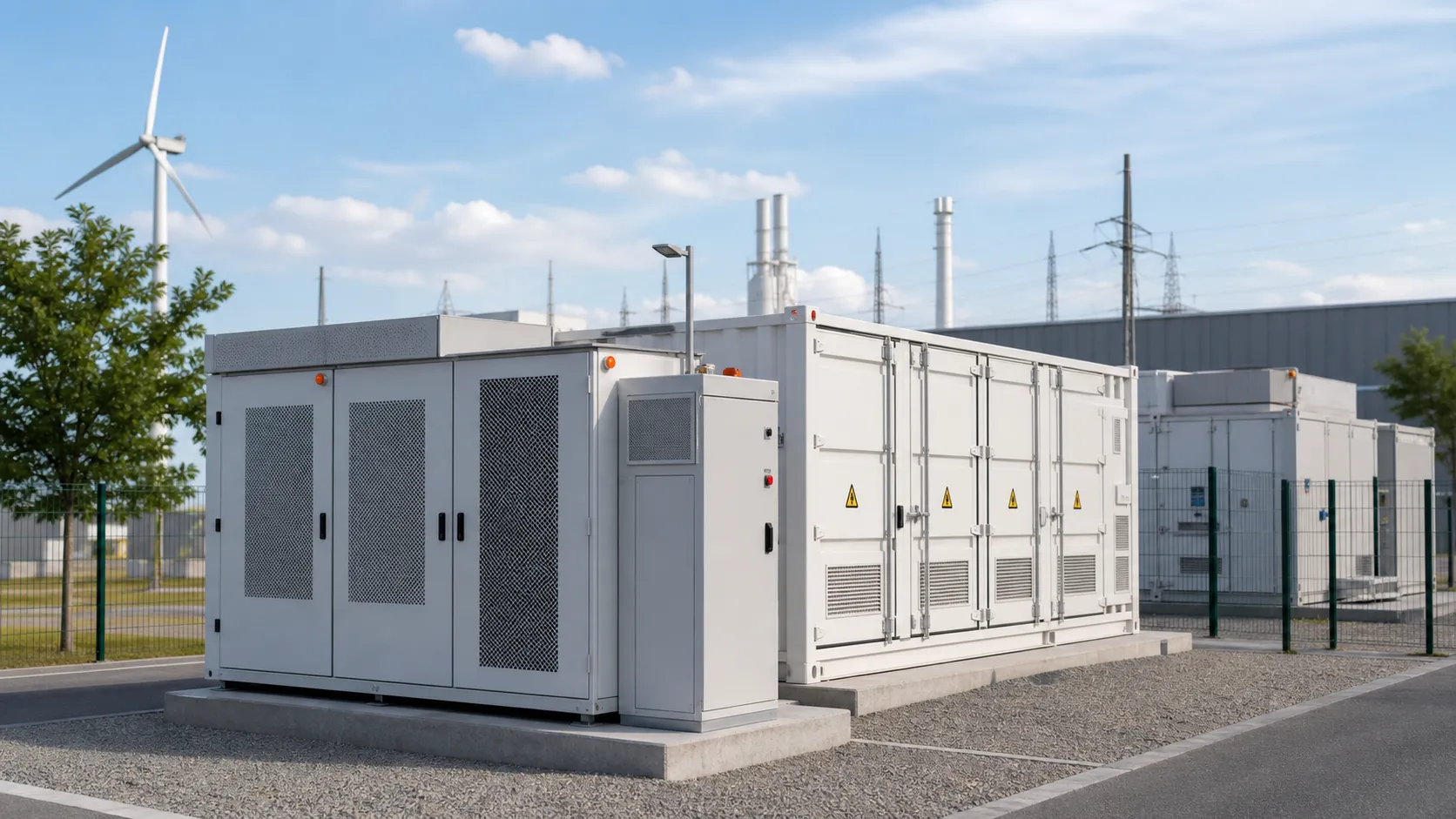
To unlock the full benefits of peak shaving, industrial battery energy storage systems (BESS) require a heavy-duty hardware and software architecture.
Core Components of Peak Shaving BESS Architecture
- High-Safety LiFePO4 Cell Chemistry: We utilize industrial-grade Lithium Iron Phosphate (LiFePO4) cells engineered for exceptional thermal stability and an operational lifespan of >=6,000 cycles at 80% Depth of Discharge (DoD).
- Active Liquid Thermal Management: Liquid cooling loops keep cell-to-cell temperature variance minimal across the entire pack, preserving long-term battery health during aggressive peak mitigation events.
- AI-Driven Cloud-Edge EMS: Real-time load forecasting algorithms execute millisecond dispatch control, triggering battery discharges automatically the instant facility consumption approaches preset peak thresholds.
- Multi-Tier Safety & Fire Suppression: Built with a 3-tier BMS architecture, early off-gas detection sensors, and targeted aerosol fire suppression to guarantee maximum protection in high-density deployments.
Hardware & Software Specifications Matrix
| Architecture Layer | Core Technology | Operational Role in Peak Shaving |
|---|---|---|
| Energy Storage Cells | Tier-1 LiFePO4 Chemistry | Delivers >=6,000 cycle lifespans with superior thermal tolerance |
| Thermal Control | Liquid Cooling Loop | Eliminates hot spots during high-current discharge intervals |
| Control Platform | Intelligent EMS & Cloud AI | Monitors facility loads in real time for automated threshold management |
| System Protection | 3-Tier BMS & Aerosol Safety | Provides full overcurrent, voltage, thermal, and off-gas safety monitoring |
By pairing heavy-duty battery hardware with tailored BMS and EMS integration, our peak shaving deployments protect facilities from expensive demand surcharges without compromising operational stability.
Implementation Roadmap: Deploying Peak Shaving with Percenec Energy
- Phase 1: Site Assessment & Interval Load Profile Analysis
We analyze your 15-minute utility interval data to establish a precise baseline of your energy consumption and isolate recurring peak demand spikes. - Phase 2: Custom Engineering & ROI Simulation
We run detailed financial simulations to accurately size power (kW) and energy (kWh) capacities. Our team delivers targeted engineering via our custom ESS integration strategy to maximize your utility demand charge reduction. - Phase 3: Automated Manufacturing & Testing
Every system undergoes rigorous Factory Acceptance Testing (FAT) before shipment to verify sub-10ms response times, cell capacity, and safety protocols. - Phase 4: Turnkey Field Integration
We deploy modular containerized units or space-saving energy storage cabinets directly to your facility, keeping site disruption and operational downtime to a minimum. - Phase 5: Grid Synchronization & Commissioning
We manage seamless electrical coupling to your distribution grid and Building Management Systems (BMS), ensuring your Maximum Import Capacity (MIC) limits are strictly enforced. - Phase 6: 24/7 Remote Monitoring & O&M Support
Our cloud telemetry platform continuously tracks hardware metrics, optimizes discharge algorithms, and handles preventive maintenance to safeguard your investment.
- Phase 1: Site Assessment & Interval Load Profile Analysis
Frequently Asked Questions About Peak Shaving
What are the benefits of peak shaving for commercial and industrial facilities?
Understanding what are the benefits of peak shaving starts with looking at your monthly utility bill. By deploying a Battery Energy Storage System (BESS), facilities actively suppress power spikes to cut overhead and protect operations.
The major operational and financial benefits of peak shaving include:
- Up to 35% Demand Charge Reduction: Automated discharge during peak intervals lowers your billable kW threshold without altering production schedules.
- 30%+ Total Energy Bill Savings: Combines peak demand mitigation with Time-of-Use (TOU) tariff arbitrage (charging cheap off-peak energy, discharging during high-rate windows).
- Transformer Upgrade Deferral: Avoids up to 50% in costly utility grid tie expansions across industrial sites and commercial buildings.
- Maximizing Solar ROI: Boosts onsite solar self-consumption rates above 90% by capturing surplus mid-day generation.
- Instant Backup Resilience: Delivers a sub-10-millisecond switchover execution to keep critical loads online during unexpected grid outages.
How does peak shaving differ from load shifting?
While both strategies optimize energy costs using automated Energy Management Systems (EMS), they target different line items on your commercial electricity bill:
| Key Aspect | Peak Shaving | Load Shifting |
|---|---|---|
| Primary Target | kW (Power Demand) | kWh (Energy Volume) |
| Operational Goal | Mitigate short-duration, high-power demand spikes | Move total energy consumption from high-tariff to low-tariff time windows |
| Financial Mechanism | Lowers Maximum Import Capacity (MIC) demand charges | Captures Time-of-Use (TOU) price arbitrage |
| BESS Trigger | Instant discharge when facility load crosses a set kW threshold | Scheduled daily charge and discharge cycles based on utility rate hours |
How fast can a BESS peak shaving system pay for itself?
Most commercial and industrial facilities see an energy storage ROI payback period of under 3.5 years. Exact timelines depend on local demand charges, tariff spreads, and load profiles:
- EV Fast-Charging Hubs: 2.5 – 3.5 years
- Manufacturing Plants: 3.0 – 3.5 years
- Cold Storage & Logistics: 3.0 – 4.0 years
- Commercial Real Estate: 3.5 – 4.5 years
Using long-life Lithium Iron Phosphate (LiFePO4) cell chemistry rated for >=6,000 cycles, modern storage assets continue generating net-positive cash flow for a decade or more after capital recovery.
Can peak shaving prevent costly utility transformer and grid connection upgrades?
Yes. Adding heavy operational loads—such as automated manufacturing lines or high-capacity fleet chargers—frequently breaches your utility grid capacity limits. Requesting a higher Maximum Import Capacity (MIC) from the utility can trigger six-figure transformer and line upgrade fees.
A peak shaving system acts as a localized power booster. It discharges battery reserves directly into facility distribution circuits during high-load events, keeping total utility draw below assigned threshold limits and deferring expensive infrastructure overhauls indefinitely.
How does peak shaving integrate with solar PV and EV fast-charging infrastructure?
An intelligent EMS unifies solar, EV fast chargers, and battery storage into a cohesive microgrid:
- Solar PV Integration: Storing excess mid-day solar power prevents curtailment and allows you to discharge clean energy during peak evening demand windows.
- EV Fast-Charging Support: EV fast chargers create instantaneous, multi-hundred-kilowatt power spikes. The BESS buffers these charge events locally, supplying required surge power so your grid connection remains flat and predictable.