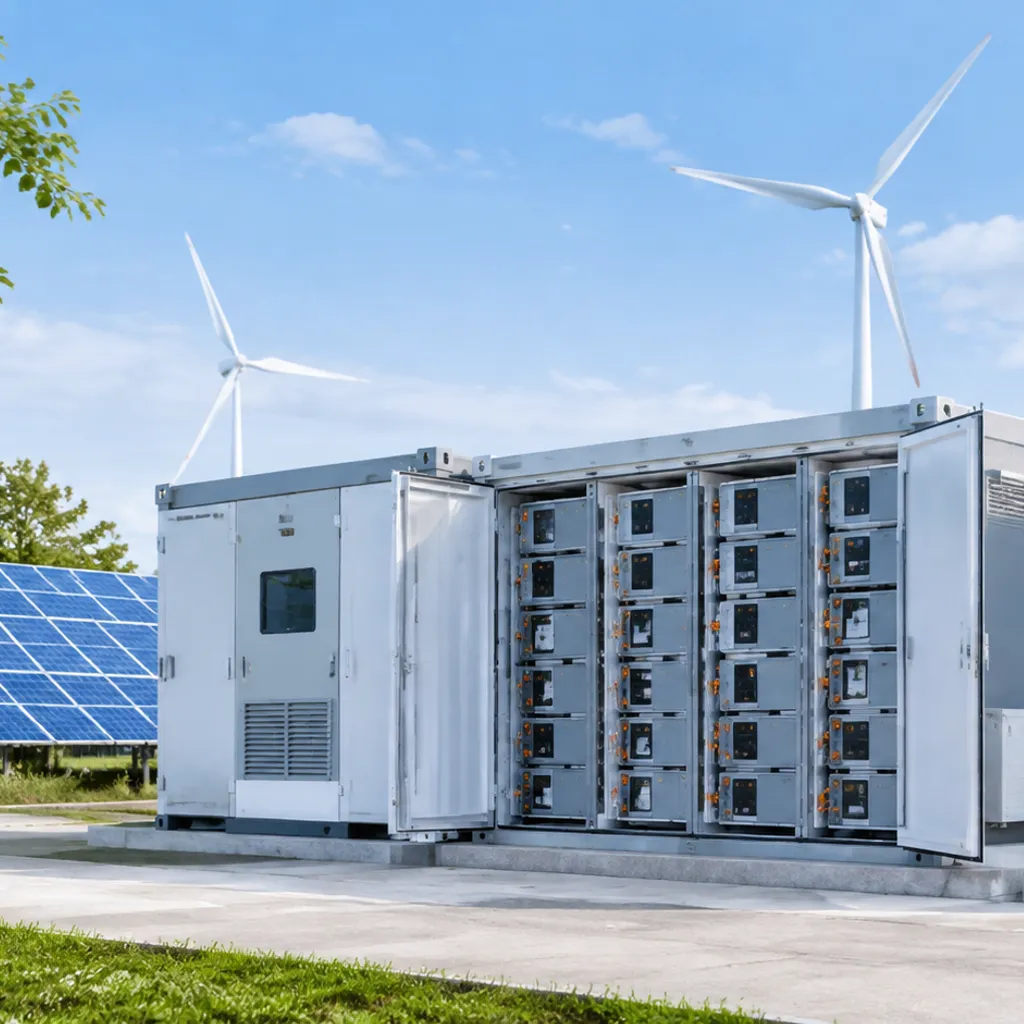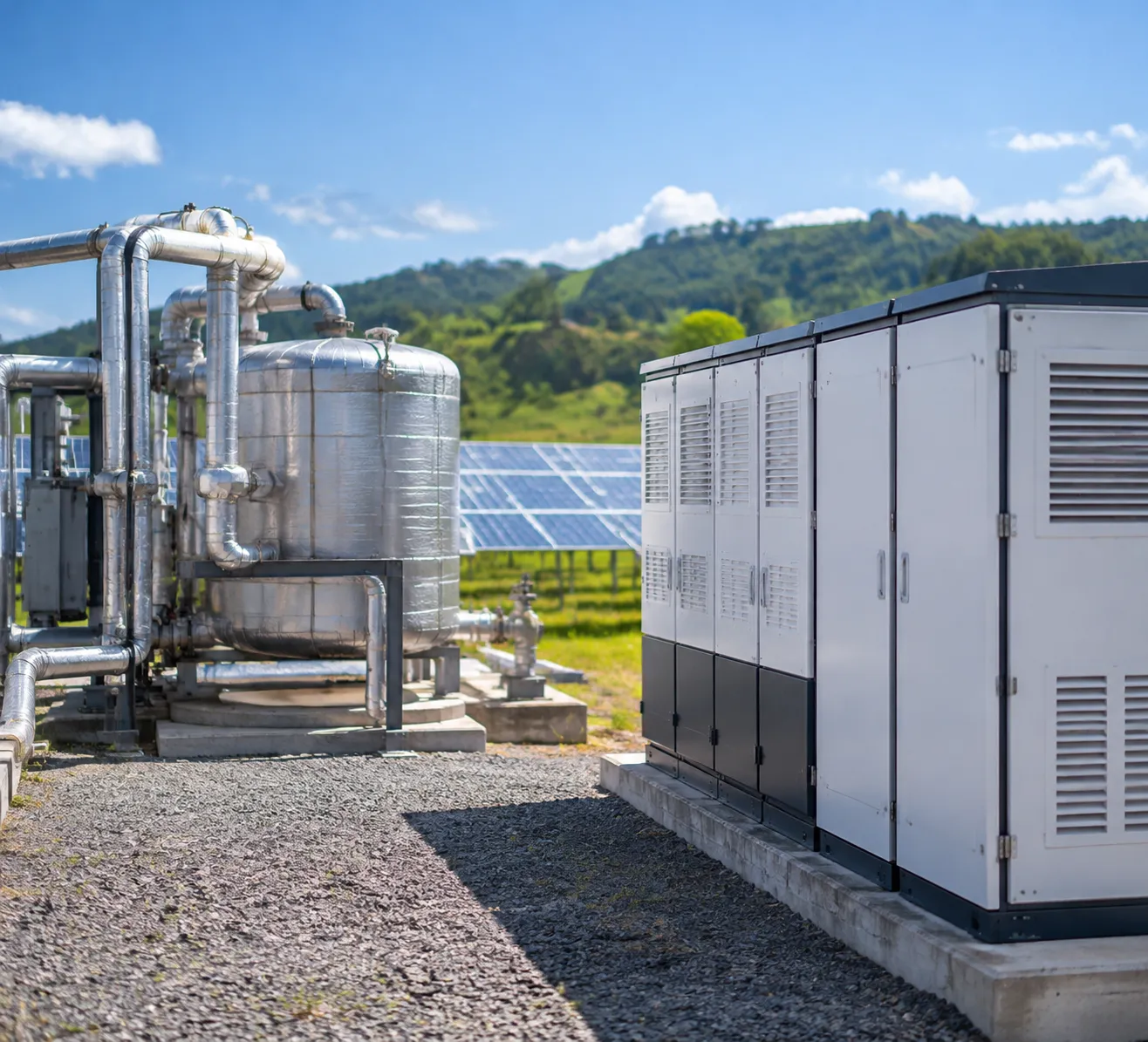

How Does a Battery Energy Storage System Work?
A battery energy storage system (BESS) captures electrical power from the grid or generation assets like solar panels, stores that energy electrochemically, and releases it whenever demand peaks or the primary grid fails. The entire process relies on synchronized interaction between chemical storage, power conversion electronics, and multi-tier digital controllers.
[ Power Source: Solar / Grid ]
│ (AC or DC)
▼
[ Bi-directional PCS ] ◄──► [ LiFePO4 Battery Bank ]
│ │
│ ▼
│ [ Multi-Level BMS ]
▼ │
[ Facility Loads ] ◄────────────┘
▲
│ (Automated Dispatch)
[ Central EMS ]
Energy Conversion Principles and Round-Trip Efficiency (RTE)
The system operates across two core cycles:
- Charging Phase: Surplus alternating current (AC) power from the grid or on-site solar passes through a power converter that rectifies it into direct current (DC), storing it chemically inside the battery cells.
- Discharging Phase: When power rates surge or grid outages occur, the stored DC energy feeds back through the inverter, converting instantly to standard AC electricity for local loads or grid export.
- Round-Trip Efficiency (RTE): RTE measures the percentage of electricity retrieved versus the electricity injected during charging. High-performance systems deliver 85% to over 90% RTE, minimizing conversion and thermal losses across each cycle.
Electrochemical Battery Bank and LiFePO4 Cell Architecture
The core of our energy storage architecture relies on Lithium Iron Phosphate (LiFePO4) chemistry. We organize these cells into modular, rack-mounted battery packs:
- Thermal Stability: LiFePO4 provides superior chemical resilience against elevated temperatures, reducing the risk of thermal runaway.
- Cycle Durability: These cells deliver long service life—typically 6,000+ cycles under standard Depth of Discharge (DoD) profiles.
- Modular Expansion: Multiple battery modules link in series and parallel, scaling capacity from small commercial rack footprints to containerized multi-megawatt setups.
Power Conversion System (PCS) and Bi-Directional Inverters
The Power Conversion System (PCS) acts as the electrical bridge between the DC battery bank and the facility's AC infrastructure.
Unlike standard unidirectional solar inverters, a BESS relies on bi-directional inverters. These units alternate instantaneously between rectifier mode (charging the DC cells with AC grid power) and inverter mode (discharging DC battery power into clean, stable AC electricity). Fast switching speeds ensure seamless transitions with negligible phase distortion.
Battery Management System (BMS) for Cell Monitoring and Safety
A robust Battery Management System functions as the primary safety barrier for the electrochemical cells:
- Continuous Telemetry: Monitors cell-level voltage, module temperatures, and current flow in real time.
- State Tracking: Calculates precise State of Charge (SoC) and State of Health (SoH) metrics to prevent overcharging or deep discharge damage.
- Dynamic Balancing: Equalizes charge levels across individual cells to maintain uniform degradation rates.
- Multi-Tier Protection: Triggers automated disconnect switches and isolates strings at the first detection of electrical or thermal anomalies.
Energy Management System (EMS) and Automated Dispatch Controls
While the BMS safeguards the hardware, the Energy Management System (EMS) directs high-level system logic. The EMS continuously evaluates utility tariff schedules, site load profiles, and solar production forecasts.
Using programmable dispatch algorithms, the EMS automatically decides when to charge during low-cost off-peak windows, when to discharge for peak shaving, and how to hold reserves for unexpected power interruptions.
Grid-Tied, Off-Grid, and Black-Start Operating Modes
Modern BESS platforms support multiple operational profiles based on site demands:
- Grid-Tied Mode: Synchronizes seamlessly with utility frequency and voltage, handling demand charge reduction, load shifting, and power factor correction without disturbing baseline grid operations.
- Off-Grid (Islanding) Mode: Disconnects from the utility via an automatic transfer switch during blackouts, establishing an independent microgrid to power critical loads continuously.
- Black-Start Capability: Energizes an unpowered facility from zero without relying on external grid voltage, providing rapid restoration during extended regional outages.
Top Advantages of Battery Energy Storage Systems
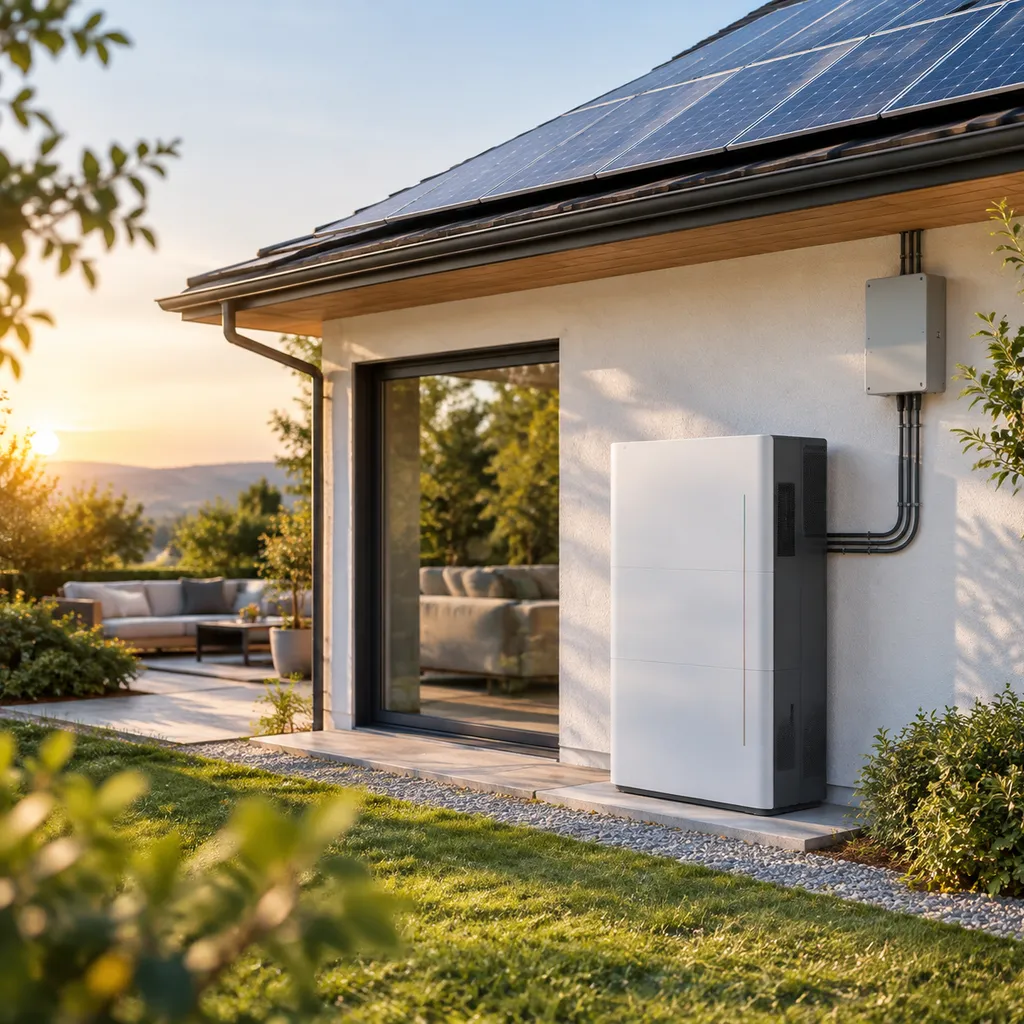
Modern industrial facilities, commercial operations, and utility networks face rising grid tariffs, unpredictable outages, and strict carbon limits. We engineer battery energy storage systems (BESS) to tackle these exact operational bottlenecks. While evaluating a new project requires weighing capital costs against operational payoffs, reviewing the complete battery energy storage system advantages and disadvantages shows how modular storage transforms electricity from an uncontrollable expense into an agile asset.
The primary operational and economic advantages of battery energy storage systems break down across several core functions.
Peak Shaving and Demand Charge Management
Utility bills for commercial and industrial facilities often hinge on peak demand charges—penalties based on the single highest 15-minute window of electricity consumption during the billing cycle. These surcharges can account for 30% to 50% of an entire monthly electric bill.
- Immediate Load Clamping: When factory motors start up, heavy chillers cycle on, or production lines peak, the BESS automatically discharges to cap incoming grid draw.
- Predictable Utility Bills: By smoothing out consumption spikes, facilities establish an artificial ceiling on utility demand, directly securing peak shaving advantages without requiring changes to daily manufacturing shifts.
Time-of-Use (TOU) Energy Arbitrage for Cost Savings
Utilities increasingly implement dynamic, time-differentiated pricing. Electricity rates during late-afternoon and early-evening peak periods can surge to several times the baseline rate.
- Charge Low, Discharge High: The system charges battery racks when retail power prices are at rock bottom—typically during late night hours or midday periods of high renewable generation.
- Automated Tariff Arbitrage: The Energy Management System (EMS) monitors tariff schedules and dispatches stored kilowatt-hours when retail grid prices hit their peak, driving steady daily savings without operational interruption.
Grid Revenue Stacking via Ancillary Services
Beyond cutting local electric bills, energy storage systems can function as revenue-generating assets. Both behind-the-meter (BTM) storage and utility-scale installations can participate in wholesale electricity markets and grid-support programs:
- Frequency Regulation: Lithium iron phosphate (LiFePO4) systems react in milliseconds to sub-second frequency deviations, keeping local grid loops balanced.
- Demand Response Participation: Facilities enroll their available battery capacity into automated utility demand response programs, earning standby payments and dispatch credits for relieving grid congestion.
- Capacity Market Contracts: Battery operators secure firm capacity contracts by guaranteeing reserve availability during extreme regional power events.
Uninterruptible Backup Power and Power Quality Stabilization
For mission-critical infrastructure, precision manufacturing, and cold storage operations, even a momentary power blip triggers expensive downtime, product spoilage, and tool recalibration.
- Sub-Cycle Switching: Paired with an integrated Power Conversion System (PCS), our storage installations isolate from the grid during blackouts and provide clean, uninterrupted power with switchover times fast enough to keep sensitive electronics online.
- Voltage and Frequency Smoothing: The system continuously cleans dirty power by filtering harmonic distortion, sagging voltages, and brief brownouts caused by fluctuating local grid feeders.
- True Energy Independence: Facilities maintain critical loads indefinitely when pairing battery banks with on-site generation, operating as resilient, standalone microgrids.
| Operational Advantage | Typical Mechanism | Primary Financial / Operational Benefit |
|---|---|---|
| Peak Shaving | Automated threshold discharge via EMS | Lowers demand charges by 20% to 50% |
| TOU Arbitrage | Off-peak grid charging, peak-hour discharge | Shrinks daytime energy volumetric rates |
| Power Quality | Bidirectional inverter reactive power compensation | Prevents equipment trips, brownout damages |
| Renewable Firming | Absorbs midday PV surplus for evening dispatch | Eliminates curtailment, raises self-consumption |
Renewable Integration and Solar Curtailment Reduction
Solar arrays and wind turbines produce power when natural resources permit, which rarely matches peak commercial load hours. Without battery storage, massive amounts of midday solar generation are curtailed (wasted) or exported back to the grid for minimal net-metering credits.
- Curtailment Elimination: A dedicated battery bank absorbs excess generation directly, ensuring zero clean energy goes unused.
- Renewable Firming: Storage smooths the intermittent output caused by passing clouds or sudden drops in wind speed, delivering a steady, predictable power output to local switchboards.
- Round-the-Clock Clean Power: By storing daylight energy for nighttime shifts, industrial users can push on-site renewable self-consumption rates above 80%.
Modular Scalability from Small Commercial Racks to Multi-MWh Containers
Energy demands rarely stay static. We build energy storage architectures around modular LiFePO4 battery enclosures that scale alongside your facility's expansion:
- Flexible Form Factors: Projects can start with a compact 50 kWh or 100 kWh rack-mounted footprint for small commercial facilities, expanding incrementally as demand grows.
- Standardized High-Density Enclosures: For large-scale C&I and utility-scale footprints, liquid-cooled, factory-assembled 20-foot shipping containers offer multi-megawatt-hour (MWh) capacities with integrated thermal management, fire suppression, and balance-of-plant hardware ready for quick field deployment.
- Future-Proof Asset Value: Modular strings allow operators to augment capacity down the line without needing to rebuild foundational civil engineering works or primary electrical distribution boards.
How to Set Up a Battery Energy Storage System Step by Step
Step 1: Conduct Load Audits and Size Your Power-to-Energy Ratio
We start by pulling at least 12 months of interval utility data (15-minute intervals work best). This reveals your real peak demand spikes (kW) and continuous consumption patterns (kWh).
- Power rating (kW/MW): Determines the maximum instantaneous output needed to suppress spikes or carry critical backup loads.
- Energy capacity (kWh/MWh): Determines how long the system can sustain that output.
- C-rate selection: Sizing the discharge duration (such as a 2-hour or 4-hour system) ensures you do not overpay for battery capacity you never cycle.
For comprehensive layout planning, reviewing an energy storage system architecture and design guide helps align your storage capacity with long-term facility goals.
Step 2: Choose Between AC-Coupled and DC-Coupled Topologies
Your system architecture determines where the energy conversion takes place.
| Feature | AC-Coupled Storage | DC-Coupled Storage |
|---|---|---|
| Best Used For | Retrofitting existing solar arrays or standalone BESS | New solar-plus-storage builds |
| Inverter Setup | Separate battery inverter and PV inverter | Shared hybrid inverter |
| Round-Trip Efficiency | Slightly lower due to dual DC-AC-DC conversions | Higher efficiency for direct solar charging |
| System Flexibility | High; independent placement and maintenance | Lower; tied to the solar array setup |
For facilities planning reliable resilience without rebuilding their current solar array, our commercial and industrial backup power systems frequently utilize AC-coupled setups for fast, non-disruptive integration.
Step 3: Secure Site Permits and Meet NFPA 855 and UL 9540 Standards
Permitting requires strict compliance with local fire codes and international safety standards:
- UL 9540 & UL 9540A: Validates the complete system integration and provides thermal runaway fire propagation testing data.
- NFPA 855: Mandates physical separation distances, maximum allowable quantities (MAQ) of energy per unit, and dedicated deflagration venting.
- Utility Interconnection: Submit your Interconnection Agreement (IA) early. Local utilities must review your single-line diagrams (SLD) to authorize grid tie-in and export controls.
Step 4: Execute Civil Works, Electrical Wiring, and Safety Interlocks
Once permits clear, physical site preparation begins:
- Foundation & Placement: Pour concrete pads designed for container or rack weights, ensuring adequate clearance from property lines and combustible materials.
- DC & AC Cabling: Route DC cabling from the battery modules to the Power Conversion System (PCS), then wire AC connections into your main switchgear through dedicated isolation breakers.
- Safety Interlocks: Connect external emergency stop (E-Stop) circuits, smoke and gas detection sensors, and aerosol or clean-agent fire suppression systems directly into the tripping mechanism of the main circuit breaker.
Step 5: Calibrate the BMS, Configure EMS Software, and Run Commissioning Tests
Hardware installation is only half the job; reliable software controls keep the system operating smoothly:
- BMS Calibration: Verify voltage balance across all cell strings, calibrate State of Charge (SoC) baselines, and test over-temperature shutoff thresholds.
- EMS Parameter Setup: Program the operational strategy based on your tariff structure—whether prioritizing automated peak shaving, self-consumption, or Time-of-Use arbitrage schedules.
- Commissioning & Acceptance Testing: Perform static insulation checks, grid-loss islanding simulations, full-load discharge tests, and black-start validation before handing the system over for normal operation.
Common BESS Implementation Pitfalls to Avoid

Deploying an energy storage project requires balancing electrical engineering, thermal design, and regulatory compliance. When planning how to set up a battery energy storage system, skipping key site details can hurt performance and delay operations. We frequently see project developers run into these four avoidable traps:
- Undersizing HVAC and Thermal Management Systems
Lithium iron phosphate (LiFePO4) cells deliver high safety and cycle life, but poor ambient control accelerates cell degradation. Skimping on cooling or ventilation causes thermal hotspots across racks. This forces the Battery Management System (BMS) to throttle charge rates to avoid thermal runaway, cutting your usable capacity when you need it most. - Oversizing Inverters Leading to Low-Load Efficiency Losses
Matching a massive Power Conversion System (PCS) to a small baseline load destroys conversion efficiency. Inverters operate at peak efficiency near their rated capacity; running them well below 20% capacity causes steep parasitic standby draw and low-load conversion penalties. Following a solid BESS sizing guide ensures your inverter power rating strictly aligns with real-world discharge profiles. - Failing to Factor Battery Degradation Curves into Project ROI
A system sized strictly for day-one nameplate capacity will fall short of operational targets by year five. High cycle frequency, deep Depth of Discharge (DoD), and extreme operating temperatures accelerate capacity fade. Financial models must account for multi-year degradation curves and include planned augmentation strategies to protect long-term revenue. - Overlooking Local Utility Interconnection and Safety Approvals
Permitting is often the longest phase of a storage installation. Failing to coordinate early with local utilities for interconnection studies, or ignoring fire codes regarding setbacks and ventilation, creates major delays. Engaging local authorities having jurisdiction (AHJs) early prevents expensive redesigns and keeps projects on schedule.
- Undersizing HVAC and Thermal Management Systems
Frequently Asked Questions About Battery Energy Storage
What is the expected lifespan of a commercial BESS?
Most commercial setups operate effectively for 10 to 15 years. The exact service life depends on how often you cycle the system, ambient operating temperatures, and daily Depth of Discharge (DoD).
Using Tier-1 Lithium Iron Phosphate (LiFePO4) cells, we typically see systems deliver 6,000 or more cycles before capacity drops to 70% or 80%. Operating a dedicated commercial lithium battery energy storage system with BMS ensures individual cell voltages and temperatures remain balanced, preventing premature cell degradation.
What is the main difference between AC-coupled and DC-coupled battery setups?
The primary difference is where the battery integrates into your electrical infrastructure.
| Feature | AC-Coupled Architecture | DC-Coupled Architecture |
|---|---|---|
| Connection Point | Main AC panel (via dedicated storage inverter) | DC bus behind the solar inverter |
| Best Application | Retrofitting existing commercial solar | Brand-new solar-plus-storage builds |
| Conversion Path | DC (Solar) → AC → DC (Battery) → AC (Loads) | DC (Solar) → DC (Battery) → AC (Loads) |
| System Flexibility | High; battery placement is independent | High round-trip efficiency for solar charging |
Understanding how does a battery energy storage system work in both configurations helps determine project costs. AC coupling offers simple plug-and-play installation for established facilities, while DC coupling eliminates unnecessary AC-to-DC conversion steps during daytime solar capture.
How do standards like UL 9540 and NFPA 855 protect against thermal runaway?
UL 9540 and NFPA 855 set strict benchmarks for safety design, installation spacing, and fire protection:
- UL 9540: Evaluates the complete system—inverter, battery packs, and software controls—as a single unit to ensure safe interaction under electrical, thermal, and software stress.
- UL 9540A Test Data: Evaluates how a single cell failure behaves and confirms that fire cannot spread from cell to cell or module to module.
- NFPA 855 Compliance: Regulates physical separation distances, maximum allowable energy capacity per indoor fire area, deflagration venting, and exhaust ventilation.
Paired with inherently stable LiFePO4 chemistry, these guidelines ensure commercial sites remain protected against thermal risks.
Can a battery storage system run off-grid during an extended blackout?
Yes. When designed with an automated transfer switch (ATS) and black-start capability, the system disconnects from the grid in milliseconds to power critical loads safely.
For facilities in remote locations or regions with frequent utility interruptions, a dedicated off-grid energy storage system with battery creates a standalone microgrid. This configuration pairs directly with local solar or generator inputs to deliver continuous power, providing practical energy independence and uninterrupted operations regardless of utility grid status.