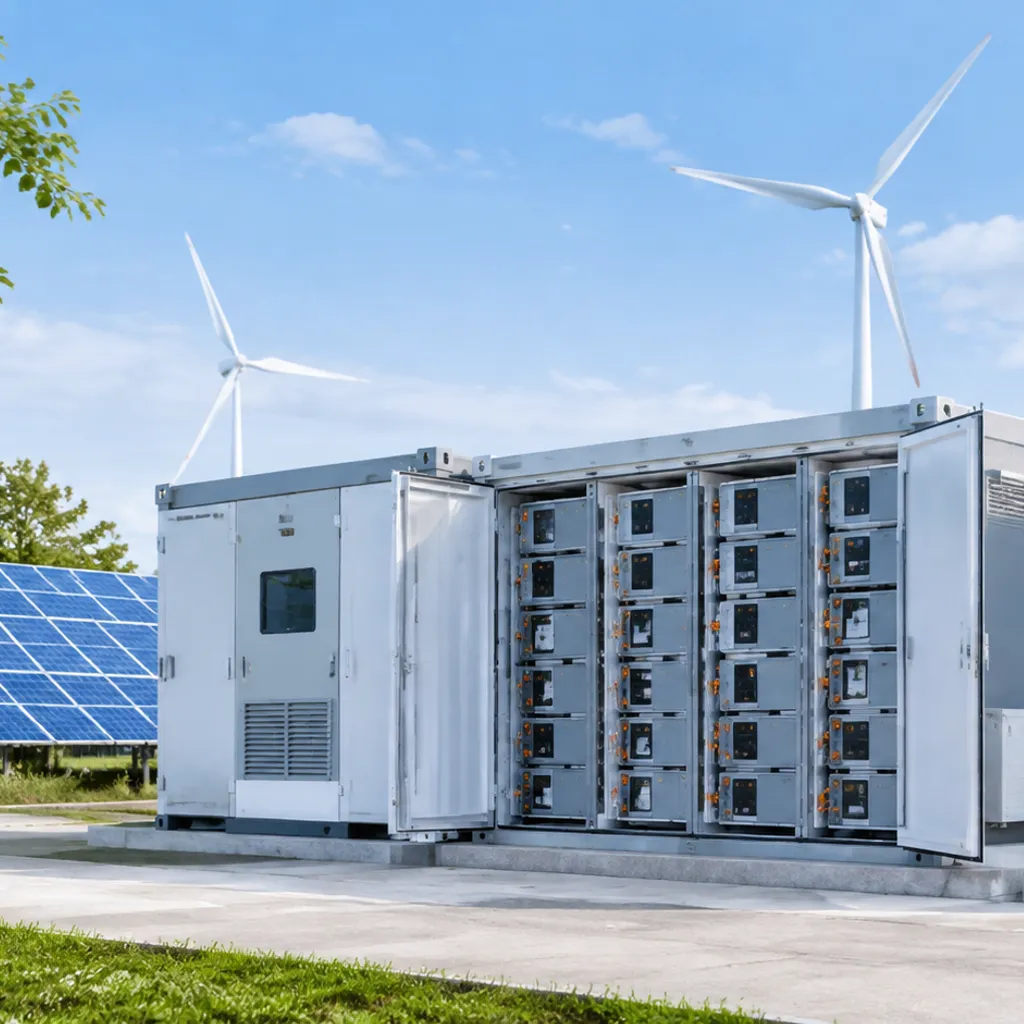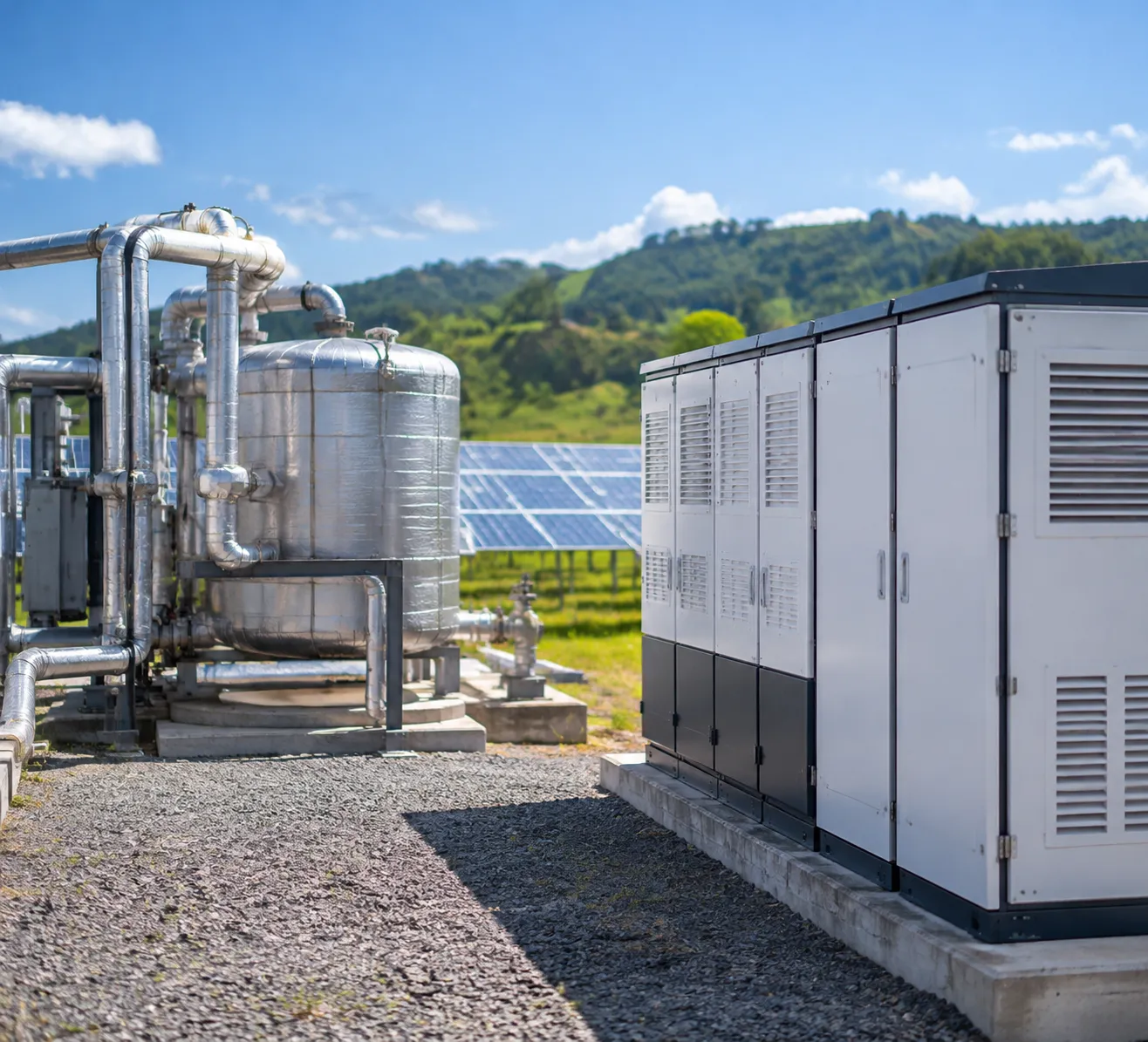

Anatomy of a Lithium Battery Energy Storage System for Solar Applications
Cell Assembly: Prismatic vs. Cylindrical
The physical foundation of any storage system lies in its cell architecture. We generally encounter two primary types:
- Prismatic Cells: Rectangular, brick-like shapes that offer superior volumetric efficiency. These are the current industry standard for LiFePO4 stationary storage, providing excellent stability and easier integration within modules.
- Cylindrical Cells: High-density, tube-shaped cells (such as the 21700 or 4680 formats). While they offer high power density, they typically require more complex thermal management hardware to prevent localized hot spots within the battery bank.
The Brain: Battery Management System (BMS)
The BMS is the most critical safety layer in the system. Without it, lithium chemistry would be unpredictable. Its primary functions include:
- Voltage Monitoring: Detecting and preventing overcharging and deep discharging, which is essential to protect the long-term integrity of the cathode and anode.
- Cell Balancing: Ensuring every cell in the series maintains the same state of charge. This prevents a single weak cell from limiting the entire module's capacity.
- Thermal Regulation: Actively monitoring internal temperatures and throttling or cutting current flow if parameters exceed safe operating limits.
Power Conversion and Management
Converting solar energy from DC to usable AC—and back to DC for storage—relies on two core components that dictate system performance:
- Bidirectional Inverter and PCS (Power Conversion System): This unit acts as the primary bridge. It converts grid or solar power to charge the battery bank and seamlessly converts stored DC energy into grid-compatible AC power to run your household appliances.
- Energy Management System (EMS): This is the software intelligence behind the hardware. The EMS handles automated dispatch, deciding exactly when to charge from solar, when to pull from the grid, and when to discharge. It also provides the critical telemetry data that allows us to monitor system health and efficiency in real-time.
Battery Chemistry Showdown: Why LiFePO4 Leads Stationary Solar Storage
When configuring a reliable lithium battery energy storage system for solar applications, battery chemistry dictates your safety margins, usable capacity, and long-term return on investment. While nickel manganese cobalt (NMC) chemistry carved out an early lead in electric vehicles thanks to its high gravimetric energy density, Lithium Iron Phosphate (LiFePO4) has proven to be the superior choice for stationary solar installations.
Thermal Runaway Resistance and Fire Safety
Safety in stationary storage systems must come first. LiFePO4 cells use extremely stable covalent bonds between iron, phosphorus, and oxygen atoms:
High thermal runaway threshold: LiFePO4 remains thermally stable up to approximately 270°C (518°F). In contrast, NMC cells begin self-heating and degrading between 150°C and 210°C (302°F–410°F).
No internal oxygen release: When subjected to thermal abuse, overcharging, or physical damage, LiFePO4 does not release oxygen during decomposition. NMC chemistry releases oxygen during thermal breakdown, fueling internal fires that are difficult to extinguish.
Reviewing our detailed lithium iron phosphate battery system safety and cycle life analysis makes it clear why modern fire codes and residential installations favor LFP modules for peace of mind.
LiFePO4 Cycle Life Expectations at 80% Depth of Discharge (DoD)
Solar battery cycling requires consistent daily charge-discharge routines—soaking up daytime solar generation and discharging across peak evening hours.
LiFePO4 longevity: High-grade LFP cells reliably deliver 4,000 to 6,000+ cycles at 80% to 90% Depth of Discharge (DoD) before degrading to 80% of original capacity. This performance translates to a 10-to-15-year operational life under daily cycling.
NMC degradation: Subjected to the same rigorous daily cycles, NMC cells usually degrade to 80% health within 1,500 to 2,500 cycles, requiring earlier pack replacement.
Lead-Acid vs. Deep Cycle Lithium Battery Usable Capacity and Lifespan
Upgrading from conventional lead-acid (flooded, gel, or AGM) to a deep cycle lithium battery eliminates major operational bottlenecks:
True usable capacity: Lead-acid banks should not be discharged past 50% DoD without suffering severe sulfation and accelerated cell death. LiFePO4 provides 80% to 95% continuous usable capacity without structural damage.
Immunity to Peukert's effect: Lead-acid capacity drops drastically when drawn at high C-rates (such as starting a well pump or air conditioner). A lithium battery maintains steady terminal voltage throughout the entire discharge cycle.
| Feature / Metric | Lithium Iron Phosphate (LiFePO4) | Nickel Manganese Cobalt (NMC) | Deep Cycle Lead-Acid (AGM/Gel) |
|---|---|---|---|
| Cycle Life (@ 80% DoD) | 4,000 – 6,000+ cycles | 1,500 – 2,500 cycles | 500 – 1,000 cycles (@ 50% DoD) |
| Usable Capacity (DoD) | 80% – 95% | 80% – 90% | 50% maximum |
| Thermal Breakdown Point | ~270°C (518°F) | ~150°C – 210°C (302°F – 410°F) | Low (Outgassing/acid boiling risks) |
| Round-Trip Efficiency | 95% – 98% | 93% – 96% | 75% – 82% |
| Service Life | 10 – 15+ years | 6 – 10 years | 2 – 4 years |
| Toxicity & Cobalt Use | Cobalt-free, non-toxic | High cobalt and nickel content | Toxic lead and sulfuric acid |
For stationary installations where weight is not the primary constraint, LiFePO4 provides the lowest cost per stored kilowatt-hour and unmatched thermal stability.
System Architecture: DC-Coupled vs. AC-Coupled Solar Storage
When we build or upgrade a solar storage layout, we evaluate two core architectural choices: whether the battery connects on the DC or AC side of the system, and whether a low-voltage (48V) or high-voltage (HV) bus best handles the power demands.
DC-Coupled Setups: Higher Round-Trip Efficiency
In a DC-coupled solar battery setup, both your rooftop solar panels and the lithium battery bank connect to a shared direct-current bus via a hybrid inverter.
- Single Conversion Step: Solar DC charges the battery directly through a Maximum Power Point Tracking (MPPT) charge controller. Power converts from DC to AC only once when sending electricity to household appliances or back to the utility grid.
- Superior Efficiency: Cutting out back-and-forth power conversion stages yields an impressive 90% to 95% round-trip efficiency.
- Optimized Solar Clipping: Hybrid inverters can route excess solar energy that exceeds the inverter's AC output rating directly into the battery, capturing watts that would otherwise be curtailed.
- Best Application: Ground-up installations and new residential solar power storage systems where you are buying panels and batteries together.
AC-Coupled Systems: Seamless Grid-Tied Retrofits
If you already have a functioning grid-tied solar array with string inverters or microinverters, tearing out operational hardware to install a hybrid inverter rarely makes economic sense. This is where an AC-coupled storage system excels.
- Independent Storage Inverter: The battery has its own dedicated bidirectional battery inverter that ties directly into your home’s main AC distribution panel.
- Triple Conversion Pathway: Solar power converts from DC to AC (solar inverter), transforms back to DC to charge the battery (battery inverter), and flips to AC a third time when discharged to power your loads.
- Efficiency Impact: These multi-stage conversions drag the round-trip efficiency down to roughly 80% to 86%.
- Zero Disruption to Existing Solar: We recommend AC-coupling when you want a straightforward solar battery backup system without altering certified rooftop wiring, voiding existing module warranties, or swapping out legacy inverters.
| Feature | DC-Coupled Architecture | AC-Coupled Architecture |
|---|---|---|
| Primary Use Case | Brand-new solar + storage installs | Retrofitting existing grid-tied arrays |
| Round-Trip Efficiency | 90% – 95% | 80% – 86% |
| Inverter Hardware | Single hybrid inverter | Separate solar inverter + battery inverter |
| Expansion Flexibility | Limited by hybrid inverter DC input ports | Highly modular; add batteries on AC panel |
| System Complexity | High initial wiring precision required | Plug-and-play wiring at the distribution board |
Low-Voltage 48V vs. High-Voltage (HV) Architectures
Once you select your coupling topology, you must match the battery bank’s operating voltage to your discharge needs.
Low-Voltage (48V Nominal) Systems
Operating between 42V and 58V DC, 48V deep cycle lithium battery setups are the global benchmark for off-grid living and standard residential backup.
Touch-Safe Voltage: The sub-60V direct-current threshold eliminates severe electrocution risks during servicing and maintenance.
Modular Paralleling: You can parallel 5 kWh to 15 kWh server-rack or wall-mount units easily over time as your storage demands grow. For standard domestic loads, a dedicated low-voltage energy storage system for solar backup offers a balance of safety, field-serviceable parts, and lower upfront hardware costs.
Current Limitations: Delivering high power at 48V requires massive amperage (e.g., 10 kW continuous draw pulls over 200 Amps). This requires thick, expensive copper cabling and generates higher resistive heat over runs longer than a few meters.
High-Voltage (HV: 150V – 600V+) Systems
High-voltage lithium battery energy storage systems wire cells in long series strings to directly align with the DC bus voltage of modern three-phase and split-phase hybrid inverters.
High-Power Throughput: Because power equals voltage multiplied by current, high-voltage systems deliver massive continuous and surge outputs at a fraction of the amperage. Delivering 10 kW at 400V requires only 25 Amps.
Lower Conductor Losses: Thinner, less expensive wiring can be run across longer distances without significant voltage drops or thermal strain.
Commercial Scale Readiness: For facilities, multi-family housing, or operations requiring sustained high-load machinery operation, scalable high-voltage setups—such as industrial-grade battery storage for solar PV system factory solutions—deliver the high discharge C-rates and thermal stability required for demanding infrastructure.
Sizing a Lithium Battery Energy Storage System for Solar Applications
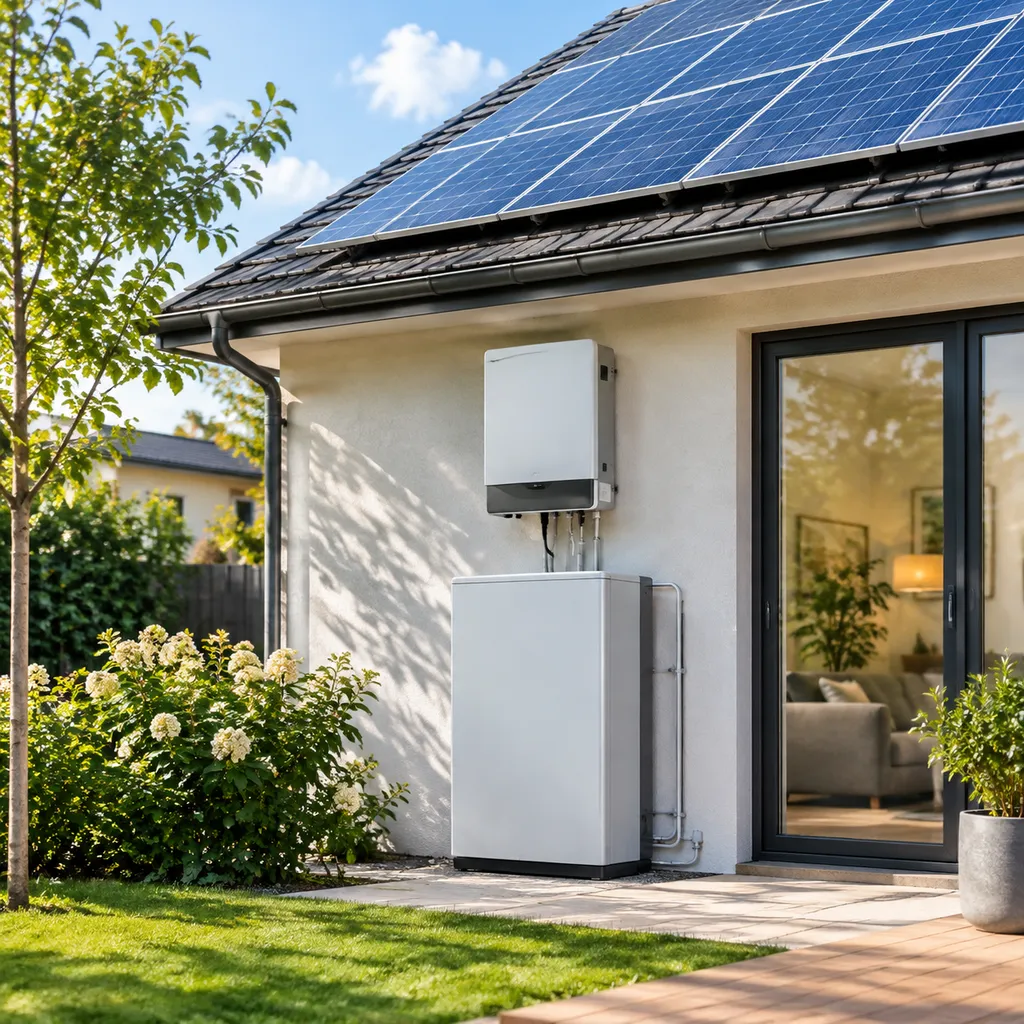
Whether you are aiming for critical load backup or whole-home independence, proper planning is essential when determining your energy storage system architecture and design to avoid oversizing or system failure. We look at sizing through two distinct lenses: energy capacity (how long it runs) and power output (how much it can run at once).
Capacity (kWh) vs. Power Output (kW)
Many users confuse these two metrics. Understanding the distinction is vital for selecting the right hardware:
- Energy Capacity (kWh): Think of this as the size of your "fuel tank." It determines how many hours your battery can support your loads.
- Power Output (kW): Think of this as your "engine size." It defines the maximum instantaneous load the battery can handle. If your appliances (like HVAC systems or pumps) draw more kW than your battery allows, the system will trigger a protection fault or shut down.
| Metric | Definition | Importance |
|---|---|---|
| Capacity (kWh) | Total energy stored in the battery | Determines duration of autonomy |
| Continuous Power (kW) | Steady output power capability | Defines what loads run simultaneously |
| Peak Power (kW) | Short-term surge output capability | Required for startup loads (e.g., motor start) |
Key Efficiency and Performance Metrics
When evaluating a lithium battery energy storage system for solar applications, you must look beyond the sticker capacity. These technical factors dictate actual, usable performance:
- Depth of Discharge (DoD): This represents the percentage of battery capacity that can be safely used without degrading the cells. Most modern LiFePO4 batteries offer a 90% to 100% DoD.
- Round-Trip Efficiency: This is the ratio of energy retrieved from the battery versus the energy used to charge it. High-quality systems typically operate at 92–95% efficiency, meaning minimal energy is lost as heat.
- C-Rate: This measures the speed at which a battery is charged or discharged. A 1C rate means a 10kWh battery can discharge 10kW in one hour. We generally prefer lower C-rates for stationary storage to extend cycle life.
Sizing Strategy: From Consumption to Autonomy
To calculate the size of the system you need, we use a standard workflow that balances your actual consumption with your reliability goals:
- Define Your Scope:
- Critical Loads: Back up only essentials (refrigerator, lights, internet, security). This lowers initial costs.
- Whole-Home: Back up everything. This requires a much larger battery bank and higher-capacity inverters.
- Calculate Daily Consumption: Total the daily kWh usage of your desired loads.
- Factor in Autonomy: Determine how many days you need to run without solar input (e.g., during consecutive cloudy days).
- Apply the Sizing Formula:
- Required Capacity = (Daily Consumption in kWh / DoD) × Days of Autonomy
- Example: If you consume 15kWh per day at 90% DoD for 1 day of autonomy: 15 / 0.9 = 16.6kWh usable.
By aligning your storage sizing with your peak sun hours and daily consumption habits, you ensure the system operates within its optimal efficiency window, protecting your investment and maximizing long-term ROI.
Core Operational Modes of a Lithium Battery Energy Storage System for Solar Applications
| Operational Mode | Primary Economic / Operational Trigger | Typical Target Application |
|---|---|---|
| Self-Consumption | Low feed-in tariffs / high retail electricity rates | Residential and light commercial |
| TOU Arbitrage | High differential between peak and off-peak rates | Areas with dynamic or tiered utility billing |
| Peak Shaving | High 15-minute peak demand penalties | Commercial and industrial (C&I) facilities |
| UPS Backup | Grid outages and power quality flickers | Critical domestic circuits, IT, and medical equipment |
| Off-Grid Autonomy | Zero grid infrastructure or isolated microgrids | Remote homesteads, telecoms, agricultural pumps |
Self-Consumption Optimization
In markets where net metering has been degraded or eliminated, exporting excess daytime solar yields negligible credit. Self-consumption mode changes the operational sequence:
- Daytime Priority: Solar arrays power running site loads first; all surplus production redirects into the deep cycle lithium battery bank rather than the grid.
- Evening Discharge: Once solar production drops below home or facility baseline consumption, the battery discharges to cover active loads.
- Result: We virtually eliminate standard evening utility imports, ensuring that up to 90% or more of your generated solar kilowatt-hours remain behind your meter.
Time-of-Use (TOU) Arbitrage
Where utilities enforce aggressive Time-of-Use billing, electricity prices swing dramatically between midday, afternoon peak windows, and midnight valleys. We configure the system's software to automate financial yield:
- Strategic Charging: The system charges to 100% capacity via midday solar or cheap off-peak grid power.
- Targeted Discharging: The energy storage system delivers power during mandatory on-peak billing hours—typically between 4:00 PM and 9:00 PM—insulating the site from the highest price tiers.
- Automated Guardrails: Intelligent state-of-charge (SoC) reserves ensure the battery never discharges below preset safety margins while cycling during high-rate windows.
Demand Charge Management via Peak Shaving
For commercial installations, utility demand charges—calculated based on the single highest 15-minute power spike in a billing cycle—can account for up to 50% of the entire monthly electric bill.
We use high-power lithium banks to actively monitor the main utility meter. The moment factory machinery, HVAC chillers, or heavy motors start and threaten to push consumption past a target threshold, the battery instantly discharges to cap the spike. By flat-lining the facility's demand curve, peak shaving delivers the fastest payback available in commercial storage setups.
UPS Functionality and Automatic Transfer Switching
A reliable solar battery backup system must protect critical infrastructure during severe grid blackouts. When utility power drops, milliseconds matter.
- Split-Second Transition: Integrated automatic transfer switches (ATS) isolate the site from the grid within 10 to 20 milliseconds, running critical circuits without dropping computers, networking gear, or refrigeration.
- Islanding Operation: The hybrid inverter safely forms an independent local microgrid, allowing rooftop panels to continue generating power and recharging batteries while neighboring properties remain dark.
- Black-Start Capability: Even if the battery completely depletes during an extended outage, built-in black-start controls automatically reboot the system as soon as morning sunlight strikes the array.
Pure Off-Grid Autonomy with Auto-Generator Support
For remote installations requiring absolute independence, we rely on a dedicated off-grid energy storage system with battery architecture. The system acts as the master voltage source for the site, maintaining pure sine wave stability across variable inductive and resistive loads.
- Two-Wire Generator Start: When poor weather depresses solar generation and pushes battery capacity below a critical threshold (typically 15–20% SoC), dry-contact relays automatically crank an auxiliary diesel or propane generator.
- Optimal Fuel Loading: Instead of running an inefficient, lightly loaded generator 24 hours a day, the generator operates at peak mechanical efficiency for 2 to 3 hours to bulk-charge the lithium bank, then shuts down cleanly.
- Long-Term Longevity: Combining robust off-grid solar energy storage with auto-cycling generators prevents deep discharges, guarantees continuous power, and minimizes engine runtime and fuel consumption.
Safety Standards, Thermal Management, and Longevity in Solar Storage
Deploying a reliable lithium battery energy storage system for solar applications requires looking past capacity numbers and focusing on thermal design and system safety. Cell chemistries perform predictably only when held within strict physical and electrical boundaries. We prioritize verified testing benchmarks and active thermal safeguards to protect customer investments against premature cell degradation and catastrophic runaway events.
Essential Compliance Certifications: UL 9540, UL 9540A, and UL 1973
Meeting rigorous international safety codes is non-negotiable for permitted indoor and outdoor installations. When evaluating hardware, we focus on three core testing protocols:
- UL 1973: Tests individual battery cells and assembled packs for extreme conditions, verifying physical impact resilience, overcharge protection, short-circuit containment, and electrical isolation.
- UL 9540: Certifies the entire system—evaluating the paired interaction between the battery pack, battery management system (BMS), and inverter under combined operational stress. Reviewing established BESS protection and safety requirements standards helps ensure projects clear local building codes and fire safety reviews without delays.
- UL 9540A: A specialized test methodology evaluating thermal runaway propagation. It forces a single cell into thermal failure to measure whether fire, toxic gases, or heat jump to adjacent cells, proving that an internal defect will not escalate into a structure fire.
Passive Cooling vs. Active Thermal Management Across Climate Extremes
Managing internal cabinet temperatures determines whether a stationary battery reaches its rated 6,000-cycle life or experiences early capacity loss.
- Passive Cooling: Relies on aluminum heat sinks, extruded casing fins, and natural ambient air convection. This setup works well for residential enclosures rated below 15 kWh located in temperate zones, eliminating parasitic power draw and mechanical wear parts.
- Active Thermal Management: Uses variable-speed exhaust fans, refrigerant chillers, or closed-loop liquid-glycol cooling plates routed directly between cell layers. Liquid cooling maintains balanced core temperatures across dense commercial battery racks during heavy multi-megawatt charge and discharge cycles, even under 45°C (113°F) desert conditions.
| Cooling Method | Best Application | Parasitic Draw | Climate Resilience |
|---|---|---|---|
| Passive Convection | Small residential (<15 kWh) | None (0W) | Moderate (0°C to 40°C) |
| Forced Air (Fans) | Mid-tier residential / Light commercial | Low (10W–80W) | High (-10°C to 45°C) |
| Active Liquid Cooling | High-voltage commercial & industrial | Medium to High | Extreme (-30°C to 55°C) |
Sub-Zero Hazards and Cold-Temperature Current Throttling
Charging lithium cells below freezing (0°C / 32°F) poses serious risks. Forcing current into cold cells causes lithium ions to accumulate on the anode surface as metallic lithium rather than intercalating into the graphite or carbon structure. This lithium plating permanently reduces usable capacity and creates internal dendrites that can puncture the separator, causing short circuits.
To prevent this hazard, a reliable BMS implements progressive current throttling:
- Above 5°C (41°F): Full rated continuous charging allowed.
- Between 0°C and 5°C: Charge rates dynamically throttled to 0.1C–0.2C to limit surface plating risks.
- Below 0°C (32°F): Complete charge disconnect.
To maintain solar storage availability in freezing climates, we utilize battery modules equipped with internal pre-heating pads. These elements use incoming solar PV power to warm the core cells above 5°C before allowing the charge circuit to engage.
Optimal Operating Temperatures to Prevent Cell Degradation
Lithium iron phosphate (LiFePO4) and NMC cells perform best within a controlled thermal envelope. Sustained exposure outside this range accelerates electrolyte dry-out and solid electrolyte interphase (SEI) layer growth.
- Ideal Sweet Spot: Maintain operating temperatures strictly between 15°C and 25°C (59°F to 77°F) to maximize lifecycle value.
- High-Heat Avoidance: Every sustained 10°C rise above 35°C doubles the calendar aging rate of the cells, degrading usable capacity regardless of cycle frequency.
- Installation Best Practices: Position enclosures away from direct afternoon sunlight, maintain a minimum 100mm clearance from walls for airflow, and avoid uninsulated, unconditioned metal sheds where ambient summer temperatures exceed 45°C.
Economic Evaluation: ROI, Payback, and Levelized Cost of Storage
When we evaluate these assets beyond the upfront sticker price by tracking actual cycle value, operational offsets, and avoided grid fees over a 10-to-15-year operational horizon.
Calculating Levelized Cost of Storage (LCOS) for Residential and Commercial Systems
Levelized Cost of Storage (LCOS) defines the true cost per usable kilowatt-hour delivered over the system's operational lifetime. To calculate LCOS, we divide total lifetime capital and maintenance expenditures by cumulative discharged energy:
LCOS = [CAPEX + Σ(OPEX / (1 + r)ᵗ)] / Σ(MWh Discharged / (1 + r)ᵗ)
- Residential solar power storage: Delivers an average LCOS between $0.10 and $0.16 per kWh, depending on cycling frequency and depth of discharge.
- Commercial installations: Scale brings down unit costs. Deploying high-utilization commercial & industrial energy storage systems drops the effective LCOS to $0.07 to $0.11 per kWh, beating peak demand utility tariffs in most deregulated energy markets.
| Metric | Residential (10–15 kWh) | Commercial (50–250 kWh) |
|---|---|---|
| Typical Installed Cost | $700 – $1,050 / kWh | $450 – $750 / kWh |
| Target LCOS | $0.10 – $0.16 / kWh | $0.07 – $0.11 / kWh |
| Average Payback Period | 7 – 9 Years | 4 – 7 Years |
| Cycling Strategy | Self-consumption & backup | Demand management & TOU |
Leveraging Tax Incentives, Clean Energy Rebates, and Utility Programs
Upfront incentives dramatically compress your capital payback window:
- Federal Investment Tax Credits (ITC): Section 48 / 25D credits offset up to 30% of total installed battery and balance-of-system hardware costs.
- State & Regional Clean Energy Rebates: Programs like California’s SGIP or regional upfront battery rebates slash initial hardware outlays by another 10% to 25%.
- Virtual Power Plant (VPP) Tariffs: Enrolling your grid-tied battery storage system into dynamic utility dispatch programs yields recurring annual capacity payments ($400–$1,200/year for residential sites).
- Demand Charge Avoidance: For businesses, active peak shaving for lower energy costs targets 15-minute load spikes, trimming up to 40% off monthly commercial electric bills.
Evaluating Throughput Warranties (MWh) vs. Calendar Warranties
Battery warranties protect your capital, but reading the fine print matters:
- Calendar Warranties (10 to 15 Years): Guarantee the hardware against manufacturing defects and natural degradation over time, usually guaranteeing 60% to 70% retained capacity at year 10.
- Throughput Warranties (Total MWh Discharged): The real performance benchmark. A standard 10 kWh lithium iron phosphate solar battery typically carries a warranty of 30 to 38 MWh throughput.
- The "Whichever Comes First" Clause: If you cycle the pack aggressively twice a day for arbitrage, you will burn through the throughput allowance long before the 10-year calendar mark expires. We prioritize manufacturers specifying at least 6,000 cycles at 80% Depth of Discharge (DoD) with clear MWh metrics.
Total Cost of Ownership (TCO) Benchmarks Across the System Lifecycle
Understanding TCO prevents unexpected replacements and operational downtime:
- Direct Hardware & Balance of System (BoS): Represents roughly 65% of the total 15-year TCO.
- Inverter Replacement Budget: String and hybrid inverters typically run 10 to 12 years before needing a refresh, requiring a planned replacement expense at year 10.
- Round-Trip Efficiency Losses: Modern LiFePO4 packs operate at 88%–94% AC-to-AC efficiency. The remaining 6% to 12% is lost as heat, which represents an ongoing operating cost when charging from grid power.
- Zero-Maintenance Advantage: Unlike flooded deep cycle lead-acid banks, a sealed lithium battery energy storage system for solar applications eliminates electrolyte monitoring, terminal cleaning, and manual equalizing charges entirely.
Buyer's Checklist: Inverter Compatibility and Hardware Selection
Closed-Loop Inverter Handshakes: CANbus, RS485, and Modbus
A reliable solar battery backup system depends on tight communication between the internal Battery Management System (BMS) and the hybrid inverter. Running an open-loop setup—where the inverter guesses capacity based strictly on terminal voltage—leads to premature cutoffs, inaccurate state-of-charge (SOC) metrics, and unbalanced charging.
- CANbus Communication: The gold standard for real-time telemetry. It delivers rapid, millisecond-level reporting of cell voltages, temperatures, and dynamic charge current limits (CCL).
- RS485 and Modbus Handshakes: Widely used industrial standards. Perfect for multi-pack configurations and monitoring platforms, provided the firmware profiles align on both sides.
- Plug-and-Play Protocol Mapping: Ensure your battery firmware contains pre-configured protocols for industry-standard hybrid inverters (such as Victron, Deye, Sol-Ark, or Schneider) to avoid manual pinout splicing and custom register programming.
Modular Expansion Limits and Future Add-ons
Energy demands inevitably grow. When you plan to increase solar energy storage capacity later, the system architecture must accommodate new modules without degrading older packs.
Parallel expansion sounds simple on paper, but mixing fresh battery modules with aged packs creates resistance mismatches. Newer modules with lower internal resistance take on a higher share of the discharge current. We recommend hardware platforms featuring automated string balancing, independent DC fusing per rack, and master-slave BMS configurations that handle at least 8 to 16 packs in parallel. For projects expanding from high-end residential setups to microgrid scales, deploying a scalable battery energy storage system ensures that busbars and control architecture tolerate future throughput without bottlenecks.
Essential Hardware Selection Matrix
| Evaluation Criteria | High-Priority Specifications | What to Avoid |
|---|---|---|
| Inverter Protocol | Pre-flashed CAN/RS485 closed-loop profiles | Open-loop, lead-acid emulation charging |
| Expansion Architecture | Dedicated busbar connections, auto-addressing BMS | Daisy-chained cables exceeding 3 parallel units |
| Voltage Architecture | Matched 48V low-voltage or 200V–600V high-voltage stack | Mixing high-voltage strings without string combiners |
| Field Serviceability | Removable BMS trays and replaceable breaker switches | Fully potted, non-serviceable sealed battery bricks |
| Warranty Throughput | Defined in total megawatt-hours (MWh) alongside 10+ years | Uncapped calendar-only warranties with ambiguous exclusions |
Support, Sparing, and Warranty Reliability
Hardware longevity is only as dependable as the manufacturer standing behind it. Field failures happen, but extended downtime kills system economics.
- Direct Access to Level-2 Support: Verify that you can reach regional field support engineers rather than tiered call centers dealing in generic ticketing.
- Local Component Sparing: Ensure replacement BMS boards, contactors, and display modules ship locally within 48 to 72 hours.
- Unambiguous Warranty Terms: Look for explicit warranty backing on both cycle life and total throughput. The contract should clearly protect against premature capacity fade below 70% within the agreed term without burying fine print about ambient temperature logs.
Frequently Asked Questions About Lithium Battery Solar Storage
How Many Years Does a Lithium Solar Battery Realistically Last?
In our field testing and real-world deployments, a quality lithium battery energy storage system for solar applications using Lithium Iron Phosphate (LiFePO4) chemistry delivers between 4,000 and 6,000 full charge-discharge cycles before hitting 80% of its initial rated capacity.
- Daily Cycling: If you cycle the battery once per day, expect 10 to 15 years of reliable service.
- Degradation Factor: Operating cells in moderate ambient temperatures (15°C to 25°C / 59°F to 77°F) and keeping depth of discharge (DoD) around 80% to 90% significantly prolongs lifespan beyond standard warranty terms.
Can I Retrofit a Lithium Battery to an Existing Grid-Tied Solar Array?
Yes. Adding battery storage to an existing array is standard practice, and you have two primary options:
- AC Coupling: We add a separate storage inverter alongside your existing grid-tied string or microinverter setup. The battery integrates directly at the main distribution panel, requiring zero changes to your existing solar wiring.
- DC-Coupled Replacement: You swap your aging string inverter for an all-in-one lithium-ion battery energy storage system that manages both solar generation and battery charging on a unified DC bus, delivering 2% to 4% higher round-trip efficiency.
What Size Lithium Battery Energy Storage System Is Required to Power a House?
For most typical households, an optimal system size ranges from 10 kWh to 20 kWh of usable capacity. The required footprint depends on whether you intend to run critical backup circuits or provide whole-home off-grid autonomy during outages.
| Backup Target | Usable Capacity (kWh) | Supported Equipment | Typical Duration |
|---|---|---|---|
| Critical Circuits | 5 – 10 kWh | Refrigeration, lights, Wi-Fi, phone charging | 18 – 24 hours |
| Standard Home | 10 – 15 kWh | Critical loads plus microwave, entertainment, well pump | 12 – 18 hours |
| Whole-Home Autonomy | 20 – 30+ kWh | Complete load panel including central heat pump / AC | 24+ hours (indefinite with solar) |
If you plan to scale up your energy demands down the road—such as adding an EV charger—we recommend deploying a modular battery energy storage system for scalable power that allows plug-and-play expansion without replacing your core equipment.
Is LiFePO4 Inherently Safer Than NMC Chemistry for Indoor Installation?
Yes. Lithium Iron Phosphate (LiFePO4) is fundamentally safer for residential basements, utility rooms, and attached garages than Nickel Manganese Cobalt (NMC).
- Thermal Runaway Resistance: LiFePO4 cells resist thermal runaway up to roughly 270°C (518°F), whereas NMC cells can experience chemical breakdown at 150°C to 210°C (302°F to 410°F).
- Chemical Stability: The chemical bonds in LiFePO4 make the cathode structurally resilient; it does not release combustible oxygen during high-heat breakdown events, drastically minimizing internal fire hazards.
What Is the Difference Between Peak Power Output and Continuous Storage Capacity?
Understanding this distinction prevents system overloads:
- Continuous Storage Capacity (kWh): This is the total amount of energy banked in your battery. A 10 kWh battery can supply a steady 1 kW draw for roughly 10 hours.
- Continuous Power Output (kW): The continuous rate at which the internal inverter delivers power to your home (typically 5 kW to 7.6 kW per residential unit).
- Peak Power Output (Surge kW): The maximum burst power a battery can supply for 2 to 10 seconds to start high-draw inductive motors, such as air conditioning compressors, well pumps, or power tools, without tripping the breaker.