Selecting the wrong partner for a grid-scale energy project isn't just a minor delay—it’s a multi-million-dollar risk. But with the market crowded with raw hardware suppliers, turnkey integrators, and software platforms, comparing utility scale battery storage system providers can quickly feel overwhelming.
Whether you're building for peak shaving, renewable integration, or long-duration arbitrage, picking the right vendor requires looking far beyond initial capital costs. You need to know how Tier 1 cell manufacturers stack up against full-service BESS integrators, which suppliers deliver verified BNEF bankability, and how features like LFP chemistry, liquid cooling, and AI-driven EMS software drive long-term ROI over a project's 20-year lifetime.
In this guide, you’ll get an insider breakdown of top global vendors, key technical performance metrics, and a direct checklist to help you select the ideal partner for your grid asset.
Let's dive right in.
Structuring the Utility BESS Ecosystem
Tier 1 Cell Manufacturers vs. Systems Integrators
Navigating grid-scale BESS procurement starts by separating cell-level production from full system packaging:
- Tier 1 Cell Manufacturers: Focus strictly on raw electrochemistry production, supply chain scaling, and cell manufacturing (primarily LFP). They deliver high-throughput battery cells but rarely manage high-voltage grid interconnection, local code compliance, or field integration.
- BESS System Integrators: Package raw cells into complete, utility-ready assets. Integrators design the structural enclosures and incorporate Power Conversion Systems (PCS), thermal management, fire protection, 3-tier Battery Management Systems (BMS), and Energy Management Systems (EMS).
The BESS Sourcing Dilemma
When structuring a procurement strategy, project developers choose between unbundled component sourcing and turnkey single-source contracts.
| Procurement Approach | Operational Strategy | Risk Profile & Asset Impact |
|---|---|---|
| Multi-Vendor Assembly | Separately sourcing battery cells, PCS, HVAC, and EMS controls across multiple vendors. | Offers lower initial equipment hardware CAPEX, but introduces severe warranty fragmentation, extended on-site commissioning, and split liability during thermal or operational failures. |
| Turnkey Single-Source | Partnering with single-source BESS integrators (e.g., Percenec Energy delivering pre-engineered 5MWh liquid-cooled containers). | Delivers single-point accountability, pre-commissioned factory acceptance testing (FAT), streamlined grid code compliance, and verified asset uptime guarantees (≥ 99.9%). |
Key BESS Procurement Drivers in 2026
Grid congestion, strict renewable integration mandates, and dynamic capacity markets dictate modern vendor selection. Our engineering assessments prioritize vendors that optimize long-term asset value:
- Levelized Cost of Storage (LCOS) Optimization: Evaluating total cost of ownership by balancing initial CAPEX, round-trip efficiency (RTE), auxiliary liquid-cooling power draw, and lifetime capacity degradation.
- Plug-and-Play Deployability: Utilizing pre-tested, ISO-standard containerized storage configurations to shrink site civil work, reduce interconnection lead times, and eliminate field assembly risks.
- Open Market Interoperability: Selecting software architectures with native Modbus TCP and open API access to support dynamic revenue stacking across energy arbitrage and ancillary frequency regulation services.
Battery Energy Storage System Component Breakdown
This video provides a direct, technical breakdown of utility-scale BESS architecture and subsystem integration, illustrating how key hardware and software components operate together on the grid.
Core Technical Benchmarks for Utility-Scale Provider Evaluation
When comparing utility scale battery storage system providers, hardware specs alone do not guarantee project success. We evaluate grid-scale BESS solutions across four fundamental engineering benchmarks to ensure maximum reliability, spatial efficiency, and long-term return on investment.
Containerized Density and Footprint Efficiency
Land acquisition, civil works, and site balance of plant (BOP) represent significant CAPEX drivers. Modern deployments leverage high-capacity enclosures to pack maximum megawatt-hours into compact footprints. Our high-density utility scale battery storage containers for solar and wind deliver up to 5 MWh in standard 20-foot enclosures, reducing site footprint requirements by up to 35% compared to legacy 2.5 MWh designs.
Cell Chemistry: LFP Dominance
Lithium Iron Phosphate (LiFePO4) has officially replaced NMC as the standard for stationary utility energy storage. LFP provides superior structural integrity under thermal stress and exceptional cycle longevity.
- Cycle Life: ≥ 6,000 to 8,000 cycles at 80% Depth of Discharge (DOD).
- Thermal Safety: High thermal runaway threshold (> 270°C) with zero risk of oxygen release during breakdown.
- Longevity: Learn more about our lithium iron phosphate battery system safety and cycle life data demonstrating lower annual capacity degradation over a 15-to-20-year project lifespan.
Thermal Management: Liquid Cooling vs. Forced Air
Active liquid cooling systems have largely superseded traditional air cooling in 5 MWh containerized energy storage systems due to tighter temperature control and lower auxiliary power overhead.
| Benchmark Parameter | Active Liquid Cooling | Traditional Air Cooling |
|---|---|---|
| Cell-to-Cell Temp Variance | ≤ 2.5°C | 5.0°C – 8.0°C |
| Auxiliary Power Parasitic Load | Low (30–40% power savings) | High (Continuous fan draw) |
| Annual Battery Degradation Rate | ~1.5% | > 2.2% |
| Volumetric Energy Density | High (Direct cold-plate integration) | Low (Requires wide airflow gaps) |
Electrical Performance and Dynamic Response
Grid-scale BESS integrators must meet strict utility interconnection standards and dynamic market requirements. Key metrics include:
- Round-Trip Efficiency (RTE): ≥ 88% system-level AC-to-AC efficiency, minimizing charging loss during energy arbitrage.
- Response Time: Sub-10 ms response times to support synthetic inertia and dynamic frequency regulation.
- C-Rate Versatility: Flexible discharge configurations from 0.25C (4-hour duration capacity firming) up to 1C (rapid ancillary dispatch).
Utility BESS Safety Architecture & Thermal Runaway Protection
Essential Certification Frameworks
| Standard | Scope & Compliance Requirement | Impact on Project Permitting |
|---|---|---|
| UL 9540A | Flammability testing for cell, module, unit, and installation levels | Mandatory for local AHJ fire code approvals and insurance |
| UL 1973 | Safety evaluation of stationary lithium battery packs | Verifies electrical, mechanical, and environmental stability |
| IEC 62619 | Safety requirements for industrial lithium cell arrays | Global baseline standard for utility stationary applications |
| UN 38.3 | Transport safety testing for lithium batteries | Prerequisite for international logistics and site delivery |
| CE Mark | Safety, health, and environmental performance compliance | Mandatory standard for European utility interconnections |
Multi-Tier Fire Safety Engineering
We enforce defense-in-depth safety protocols across every deployment to isolate thermal events and safeguard site assets:
- Early Gas Detection: We deploy pack-isolated battery storage fire detection systems with off-gas sensors to detect electrolyte off-gassing (hydrogen and CO) minutes before smoke detectors or temperature sensors register thermal runaway.
- Targeted Aerosol vs. Deluge Suppression: Module-level aerosol suppression systems extinguish localized electrical fires without destroying surrounding gear, backed by dry-pipe water deluge systems for emergency cooling redundancy.
- Structural Containment Barriers: Fire-rated structural separation barriers isolate battery racks within the container, preventing cell propagation across adjacent compartments and keeping damage localized.
Software Architecture: BMS, EMS, and Grid Interoperability
When comparing utility scale battery storage system providers, software functionality is what separates simple component packagers from high-performing grid assets. A robust digital architecture protects electrochemistry, maximizes operational revenue, and maintains sub-second utility responsiveness.
Active Cell Balancing BMS Architecture
We deploy a structured 3-tier Battery Management System (BMS) topology that provides granular control from individual cells up to complete high-voltage container arrays:
- Cell-Level Monitoring: Continuous tracking of cell voltage, temperature, State of Charge (SOC), and State of Health (SOH).
- Bidirectional Active Balancing: Rather than burning off excess power as waste heat through passive resistors, active balancing transfers energy dynamically between cells during charge and discharge. This reduces cell variance and extends overall cycle life.
- System-Level Safety: Real-time insulation monitoring and early fault isolation prevent localized voltage deviations from spreading across the string.
Battery Energy Management System (EMS) & Edge Intelligence
Edge-computing algorithms embedded directly within our battery energy storage systems turn raw capacity into a responsive asset. Our EMS architecture executes complex operational strategies automatically:
- AI-Driven Peak Shaving: Predictive algorithms track dynamic load curves to shave demand peaks and eliminate high tariff penalties.
- Solar-Plus-Storage Optimization: Algorithmic dispatch coordinates solar generation with storage charge states, minimizing curtailment and maximizing renewable energy capture.
- Microgrid Control: Automated mode switching supports seamless transitions between grid-tied operations and islanded microgrid power delivery.
Industrial Communication Standards for Utility SCADA
Reliable grid integration requires open protocols that interface directly with independent system operators (ISOs) and utility control centers. When evaluating how to select BESS key factors and sizing, communication flexibility is paramount:
- Native Protocols: Built-in compatibility with Modbus TCP, CAN bus, DNP3, and IEC 60870-5-104.
- Open API Architecture: Direct API access for third-party energy trading software, market aggregators, and central SCADA platforms.
- Sub-10ms Response: High-speed data buses deliver the response times necessary for fast frequency regulation and synthetic inertia grid support.
Utility BESS LCOS and Project ROI Metrics
Calculating Levelized Cost of Storage (LCOS)
To establish an accurate Levelized Cost of Storage (LCOS), we calculate total lifecycle expenditure against net energy discharged over project life:
- CAPEX: Primary equipment, Balance of System (BOS), transformer integration, site engineering, and grid interconnection costs.
- OPEX: Routine preventative maintenance, auxiliary power overhead (liquid cooling consumption), software subscriptions, and component servicing.
- Charging Energy Costs: Electricity costs incurred during charging cycles, adjusted for Round-Trip Efficiency (RTE) losses.
- Lifetime Energy Yield: Net energy delivered across the asset operating lifespan, factoring in annual electrochemical degradation. Evaluating these financial variables early is essential when reviewing an LFP battery storage safety, cost, and lifespan guide to benchmark capital requirements.
Revenue Stacking Capabilities
Maximizing project returns requires an Energy Management System (EMS) capable of executing dynamic revenue stacking across multiple market mechanisms simultaneously:
| Revenue Stream | Operational Function | Technical Requirements |
|---|---|---|
| Energy Arbitrage | Charge during low/negative pricing; discharge during peak demand. | Daily deep cycling capability, high C-rate flexibility. |
| Frequency Regulation | Rapid injection/absorption to stabilize grid frequency deviation. | Response time < 10 ms, high Round-Trip Efficiency. |
| Synthetic Inertia | Instantaneous power injection during sudden frequency drops. | Sub-second inverter control, high surge capacity. |
| Capacity Firming | Smoothing intermittent output from co-located solar/wind assets. | Continuous discharge reliability, predictable degradation profiles. |
Payback Timelines and Availability Guarantees
We structure procurement frameworks to hit target ROI timelines within 3 to 5 years. Achieving these targets requires strict contractual protections:
- ≥ 99.9% Availability Guarantees: Downtime during peak pricing windows directly degrades project yields. We require contractually enforced 99.9% uptime terms backed by liquid damages.
- Bankability & Tier 1 Status: Securing non-recourse debt financing requires providers with recognized BNEF Tier 1 energy storage standing and balance-sheet-backed warranties.
- Capacity Retention Warranties: Degradation covenants must guarantee minimum end-of-warranty capacity (e.g., 70% capacity at year 15 or 6,000+ cycles).
Comparing Utility Scale Battery Storage System Providers
When comparing utility scale battery storage system providers, project developers and EPC managers generally encounter three distinct vendor archetypes. Choosing the right partner depends on whether your project prioritizes cell-level pricing, specialized grid software, or unified single-source accountability.
| Provider Category | Example Vendors & Platforms | Primary Core Competency | Typical Trade-offs |
|---|---|---|---|
| Cell-Centric Suppliers | CATL (EnerD), BYD (MC Cube) | High-volume cell manufacturing & electrochemistry | Requires third-party systems integration and complex warranty handling |
| Legacy Pure-Play Integrators | Fluence (Gridstack), Tesla (Megapack) | Software-heavy grid controls & established market platforms | Premium pricing, potential supply chain dependencies on external cell foundries |
| Turnkey Single-Source Providers | Percenec Energy | Full-stack vertical integration (Cells, PCS, EMS, Enclosure) | Requires early-stage project alignment for standardized modular architectures |
Cell-Centric Suppliers
Cell-centric manufacturers focus primarily on mass producing high-density energy storage cells and basic rack modules.
- High Volume Production: Companies like CATL and BYD leverage massive scale to drive down cell-level capital expenditure.
- Tier 1 Electrochemistry: Proven LFP cell chemistry delivers high thermal stability and cycle life exceeding 6,000 cycles.
- Scope Limits: These suppliers typically do not handle localized engineering, site-level interconnection, or long-term system-level O&M, shifting integration risks back onto the developer.
Legacy Pure-Play Integrators
Pure-play integrators source cells from external foundries and wrap them in custom enclosures combined with proprietary software controls.
- Grid Platform Software: Software platforms from providers like Tesla and Fluence excel at complex market dispatch and frequency regulation.
- Interface Standardization: Standardized utility enclosures simplify initial site planning and balance of plant (BOP) design.
- Warranty Friction: Splitting software and cell manufacturing across separate entities can create friction during performance degradation claims or system downtime disputes.
Turnkey Single-Source Providers
Single-source providers eliminate split responsibilities by manufacturing, assembling, and controlling the complete energy storage system under one roof.
We design our solutions to remove multi-vendor complexity by unifying hardware, liquid thermal management, and controls. Utilizing a fully integrated 20ft 5MWh liquid-cooled battery energy storage system, our hardware operates under a single control architecture. This vertical integration allows us to deliver end-to-end custom ESS integration backed by verified 99.9% availability guarantees and unified warranty coverage.
Utility Scale BESS Delivery Models: Multi-Vendor Assembly vs. Single-Source Turnkey Execution
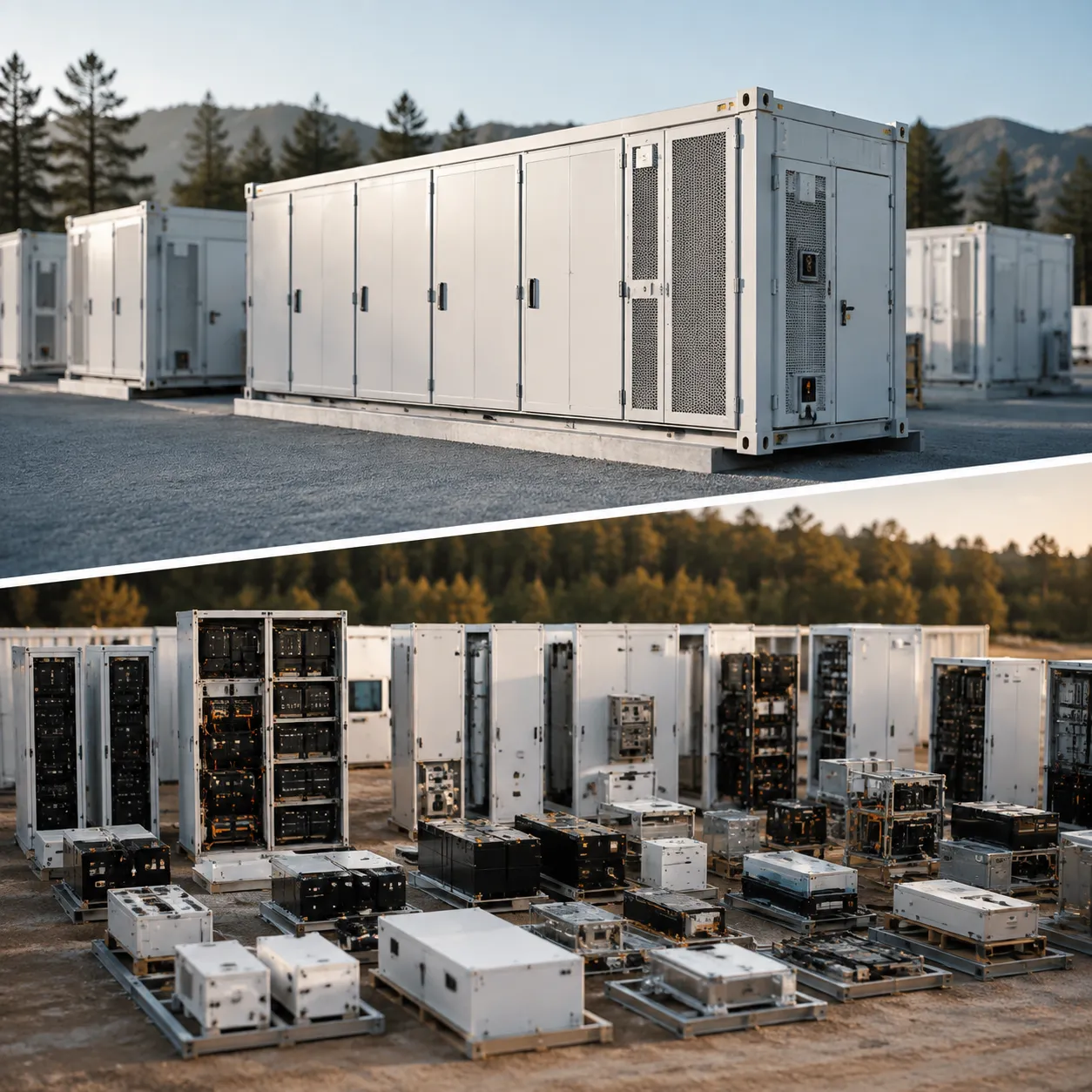
When comparing utility scale battery storage system providers, project developers and EPC managers face a fundamental delivery decision: piecing together components from separate vendors or partnering with a single-source turnkey provider.
Risk Profile Breakdown: Managing Warranty and Liability Friction
Splitting procurement across separate cell, PCS, EMS, and thermal management suppliers creates severe structural risks during deployment and ongoing plant operations.
- Warranty Fragmentation: A system fault often triggers finger-pointing between cell manufacturers, power conversion suppliers, and software developers. Resolving operational downtime claims becomes a prolonged dispute rather than a quick technical repair.
- Integration Friction: Protocol mismatches between third-party EMS software and hardware interfaces lead to unexpected delay during plant commissioning and grid response verification.
- Single-Point Accountability: A single-source execution model wraps total system performance under one commercial contract. You secure a unified warranty, explicit capacity availability guarantees, and one engineering team directly accountable for plant uptime.
| Risk Dimension | Multi-Vendor Assembly Model | Single-Source Turnkey Execution |
|---|---|---|
| Liability Structure | Split across 4–6 component vendors | Single contract holder wrapper |
| Commissioning Speed | High delay risk (protocol testing) | Pre-tested, integrated factory assembly |
| O&M Service SLA | Tiered response times per component | Unified 24/7 field service & spare parts |
The 6-Phase Turnkey Execution Framework
We de-risk utility-scale energy deployments through our end-to-end, proven turnkey BESS project delivery framework that manages every step from initial modeling to long-term commercial operations:
- Site Assessment & Modeling: Evaluating grid connection points, spatial footprint constraints, and revenue-stacking charge/discharge profiles.
- Custom System Engineering: Tailoring containerized enclosure layouts, high-voltage transformer interfaces, and liquid cooling configurations.
- Automated Production & FAT: Complete pack-to-enclosure assembly and integrated Factory Acceptance Testing (FAT) prior to site dispatch.
- Logistics & Interconnection: Coordinating heavy-haul freight, foundation placement, and civil high-voltage grid interconnection work.
- Commissioning & Energization: Executing on-site functional safety checks, UL compliance verification, and utility dispatch sign-off.
- Lifetime O&M: Delivering 24/7 remote telemetry monitoring, scheduled preventative maintenance, and long-term capacity retention guarantees.
BESS Project Procurement Checklist: 10 Critical Questions for Providers

Financial Standing & Warranty Accountability
- 1. Bankability & Tier 1 Tracking: What is your corporate balance sheet standing, parent company backing, and historic listing on the BloombergNEF (BNEF) Tier 1 energy storage index?
- 2. Single-Source vs. Split Warranty: Do you provide direct, single-point warranty accountability for the complete system, or is liability fragmented across individual cell, PCS, and EMS sub-vendors?
Safety Architecture & Compliance
- 3. Off-Gas Detection & Certification: What is the activation response time of your pack-level off-gas sensors, and are full UL 9540A fire safety testing reports available at the cell, module, and unit level?
- 4. Thermal Runaway Mitigation: How are physical containment barriers and active fire suppression systems configured to prevent thermal propagation across high-density battery racks?
Thermal Management & Auxiliary Overhead
- 5. Parasitic Power Draw: What is the auxiliary power consumption overhead of your liquid cooling system when operating at maximum discharge under extreme ambient temperatures (above 45°C)?
- 6. Containerized Footprint Efficiency: How does your unit footprint optimize spatial density while maintaining clear maintenance access? Reviewing comprehensive BESS container specifications helps verify spatial and transport compliance early in civil engineering.
Performance & Lifecycle Guarantees
- 7. Lifetime Capacity Guarantees: What are the exact terms covering end-of-life battery capacity degradation, cycle counts, and operating C-rate limits over the full contract lifecycle?
- 8. AC Round-Trip Efficiency (RTE): What is the baseline, system-level AC-to-AC RTE guarantee, accounting for all auxiliary transformer and cooling losses?
Grid Integration & Field Service SLAs
- 9. Communication & Dispatch Protocols: Does the edge controller support Modbus TCP, CAN bus, and open APIs for direct SCADA integration and real-time market dispatch?
- 10. Local Field Service & SLA Terms: Where are your local spare parts warehouses located, and what is the guaranteed response time in your O&M Service Level Agreement (SLA)? Refer to our strategic BESS buying guide to structure these technical requirements into standard supplier RFP documents.
Frequently Asked Questions
BESS Cell Manufacturer vs System Integrator
A cell manufacturer produces raw electrochemistry (cathodes, anodes, bare cells). A BESS system integrator packages those cells into a complete, grid-ready asset—combining modules with Power Conversion Systems (PCS), thermal management, safety controls, and edge software.
| Feature | Cell Manufacturer | BESS System Integrator |
|---|---|---|
| Primary Focus | Electrochemistry and mass cell production | Engineering, packaging, and grid integration |
| Scope of Supply | Bare cells or basic battery modules | Enclosures, PCS, EMS, BMS, and fire safety |
| Compliance | Component-level testing (UL 1973) | Full system certification (UL 9540, UL 9540A) |
| Warranty & Service | Cell performance guarantees only | Single-point accountability, performance SLAs, and field O&M |
When comparing utility scale battery storage system providers, partnering with vertically integrated providers ensures you receive a fully engineered all-in-one lithium-ion battery energy storage system without managing fragmented component warranties.
Why Liquid Cooling Dominates 5MWh Utility Containers
In high-density 5MWh 20-foot containerized energy storage systems, active liquid cooling outperforms traditional forced-air cooling across every core metric:
- Thermal Uniformity: Keeps cell-to-cell temperature variance within 3°C, preventing thermal hotspots.
- Parasitic Load Reduction: Uses up to 40% less auxiliary power than HVAC air systems under extreme ambient conditions.
- Cycle Longevity: Slashes thermal degradation rates, helping LFP cells achieve 6,000+ cycle lifespans.
- Compact Footprint: Enables high spatial density without sacrificing cooling efficiency.
Market Dispatch via Open APIs and Modbus TCP
Modbus TCP handles local, real-time communication between the Battery Management System (BMS), PCS, and site controllers. Open APIs connect the site to cloud-based Energy Management Systems (EMS) and utility SCADA networks.
This communication stack enables:
Sub-10 ms Response Times: Instantaneous signal exchange required for frequency regulation and ancillary services.
Automated Market Bidding: Real-time algorithmic dispatch for energy arbitrage and demand charge management.
Vendor Agnosticism: Simple integration with third-party software platforms without proprietary lock-in.
Mandatory Fire Safety Certifications for Permitting
Securing local permitting and utility interconnection requires compliance with recognized international safety standards:
- UL 9540: Standard for energy storage systems and equipment safety.
- UL 9540A: Mandatory thermal runaway fire propagation testing report for local AHJ approval.
- UL 1973: Battery pack safety certification for stationary applications.
- IEC 62619: Global safety requirements for industrial lithium-ion secondary cells and modules.
- NFPA 855: Operational and installation standards for stationary energy storage deployments.