Core Economic Drivers: How BESS Cuts Industrial Facility Energy Costs
Automated Peak Shaving to Slash 15-Minute Utility Demand Charges
Utility demand charges can represent up to 50% of an industrial facility's monthly electric bill. These charges are typically set by the single highest 15-minute interval of energy consumption during a billing cycle.
- Immediate Load Clamping: Our high-response storage systems automatically discharge stored energy the instant facility demand crosses your designated threshold.
- Seamless Threshold Tracking: Heavy inductive machinery, arc furnaces, and large compressor start-ups run smoothly without triggering utility demand spikes.
- Direct Bottom-Line Relief: Flattening your site load profile delivers predictable, recurring demand charge reduction every billing period.
Time-of-Use (TOU) Energy Arbitrage During Peak Utility Windows
Energy costs fluctuate wildly depending on grid demand and regional tariff schedules. We program our commercial BESS installations to capitalize on these price spreads automatically.
- Off-Peak Charging: The battery bank charges overnight or during mid-day surplus generation when electricity prices hit their lowest tier.
- On-Peak Discharging: Stored power deploys during the most expensive peak tariff windows, completely bypassing high spot-market utility rates.
- Automated Dispatch: Integrated controls run tariff tracking continuously, extracting maximum value from dynamic time-of-use rate structures without interrupting production lines.
Bridging Power and Critical Equipment Protection Against Voltage Sags
Power quality events such as millisecond voltage sags, phase imbalances, and harmonic distortions cost industrial facilities millions in scraped raw materials and damaged machinery.
| Power Quality Issue | Direct Facility Impact | BESS Mitigation Mechanism |
|---|---|---|
| Voltage Sags & Swells | Tripped motor drives, robotic cell halts | Sub-cycle synthetic inertia and rapid reactive power support |
| Micro-Outages (< 2 sec) | Reset industrial automation controllers (PLC) | Instantaneous bridging power delivery with zero switchover delay |
| Harmonic Distortion | Overheated transformers and switchgear failure | Continuous active filtering and power conditioning |
Our systems act as a resilient electrical shock absorber, ensuring precision production lines operate uninterrupted regardless of external grid fluctuations.
Monetizing Industrial Flexibility Through Demand Response and Grid Services
A modern industrial battery system is both a cost-cutting asset and an active revenue generator. Industrial operations possess flexible energy capacity that grid operators pay handsomely to access.
- Demand Response Participation: Curtail your grid load on notice by switching smoothly to battery power, capturing lucrative utility incentive checks.
- Frequency Regulation & Ancillary Services: Provide high-speed bi-directional power flow to regional grid networks, earning steady payments for grid-stabilizing support.
- Revenue Stacking: We configure your operational profiles to layer demand response and capacity market earnings on top of standard behind-the-meter peak shaving for accelerated capital payback.
Technical Anatomy and Architecture of an Industrial BESS
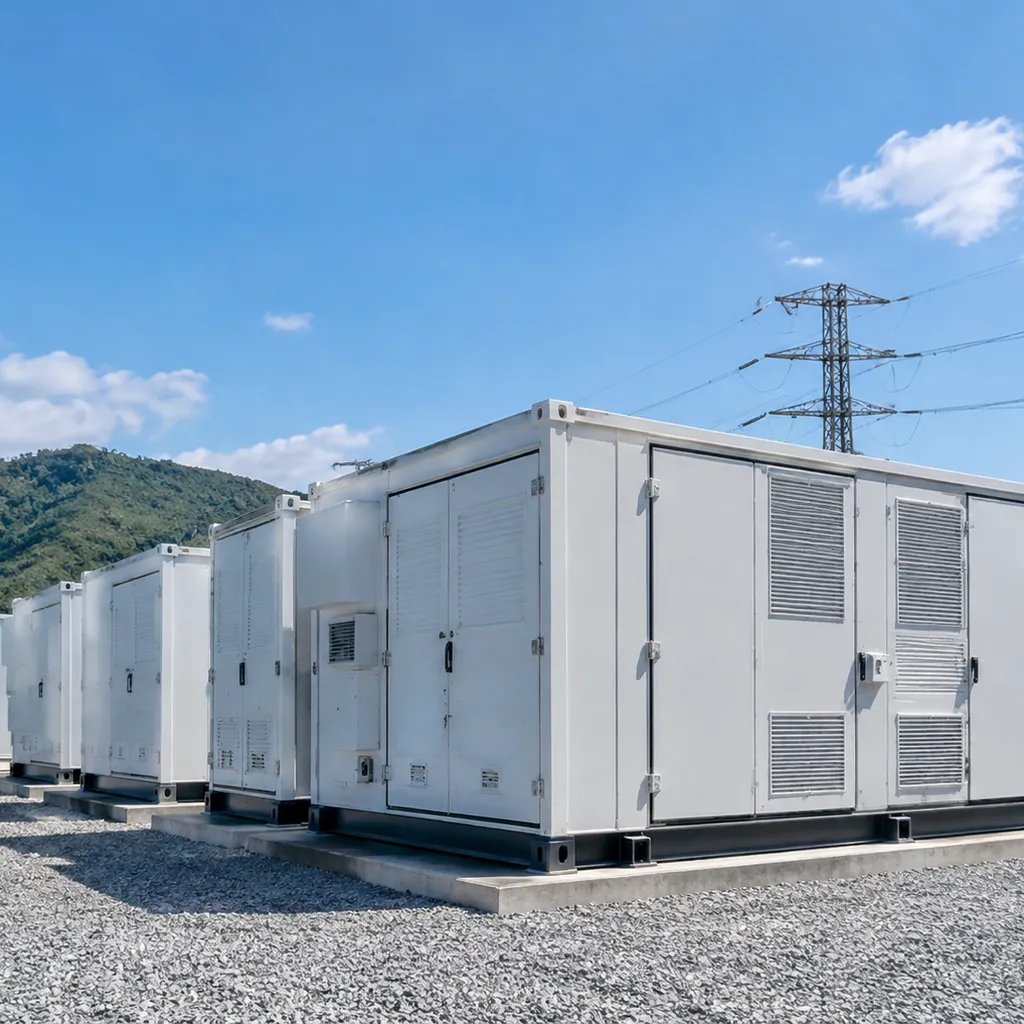
Deploying a dependable battery energy storage system bess industrial facility setup requires choosing the right hardware and control layers. We engineer our industrial energy storage architectures around four primary building blocks: high-durability cells, bidirectional power electronics, intelligent plant controllers, and active thermal management.
A deep dive into our energy storage system architecture and design guide outlines how these components interlock inside containerized industrial enclosures.
[ Industrial Facility SCADA / EMS ]
↓ (Modbus TCP / DNP3)
[ Four-Quadrant Power Conversion System (PCS) ]
↓ (Bidirectional DC/AC)
[ Battery Racks: LFP Cells + Liquid Cooling Blocks ]
Lithium Iron Phosphate (LFP) Chemistry and Cycle Life
For heavy industrial use, we standardize on Lithium Iron Phosphate (LFP) battery chemistry. Compared to nickel-based chemistries, LFP delivers structural chemical stability, higher thermal runaway thresholds, and non-toxic composition.
- Cycle Life: 6,000 to 8,000 full cycles at 80% Depth of Discharge (DoD) before hitting end-of-life capacity margins.
- Thermal Margin: Cell decomposition occurs above 270°C, providing superior passive safety during high C-rate throughput.
- Operational Longevity: 10 to 15 years of daily cycling without early rack replacement.
Review the detailed breakdown of lithium iron phosphate battery system safety and cycle life to evaluate cell stability under intense charge-discharge profiles.
Four-Quadrant PCS and Grid-Forming Inverters
The power conversion system (PCS) handles bidirectional AC/DC power flow between facility switchgear and DC battery racks. We deploy four-quadrant, grid-forming PCS units designed to:
- Manage active power (P) for charging and load shedding while concurrently supplying reactive power (Q) for power factor correction.
- Maintain facility voltage and frequency within tight tolerances during utility voltage sags and momentary outages.
- Transition seamlessly from grid-following to islanded, grid-forming operation to safeguard sensitive motor drives, robotics, and industrial automation networks.
Industrial EMS and SCADA Integration
The Energy Management System (EMS) serves as the software brain of the facility BESS. It interfaces directly with plant supervisory control and data acquisition (SCADA) platforms via standard industrial protocols like Modbus TCP, DNP3, and IEC 61850.
- Sub-Second Dispatch: Automatically shifts battery power within milliseconds of detecting plant demand spikes.
- Dynamic Setpoint Control: Synchronizes with plant PLC networks to prevent utility peak-demand ratchet penalties without interrupting manufacturing lines.
- Autonomous Operation: Executes localized automated control routines even during wide-area network disconnects.
Direct Liquid Cooling vs. Forced-Air Thermal Management
Consistent cell temperatures are essential to prevent premature capacity fade and cell mismatching. For industrial facilities running aggressive multi-cycle shifts, our configurations prioritize direct liquid cooling over forced-air systems.
| Thermal Parameter | Direct Liquid Cooling | Forced-Air Cooling |
|---|---|---|
| Cell Temperature Delta | Maintains cell-to-cell variance within ±2°C | Variance ranges between ±5°C to ±8°C |
| Cooling Efficiency | Up to 30% lower auxiliary power consumption | Higher HVAC parasitic draw under full load |
| Enclosure Footprint | Compact, high-density container packaging | Requires larger airflow corridors and ducts |
| Ambient Tolerance | Rated for extreme outdoor climates (-30°C to 50°C) | Struggles during ambient summer heat peaks |
| Noise Levels | Quiet operation; closed-loop fluid circulation | High acoustic signature from continuous exhaust fans |
Direct liquid cooling maintains uniform thermal profiles across every cell module, ensuring that your industrial energy storage system delivers maximum round-trip efficiency and predictable operational lifespan.
Industrial Facility Safety, Fire Mitigation, and Compliance Standards
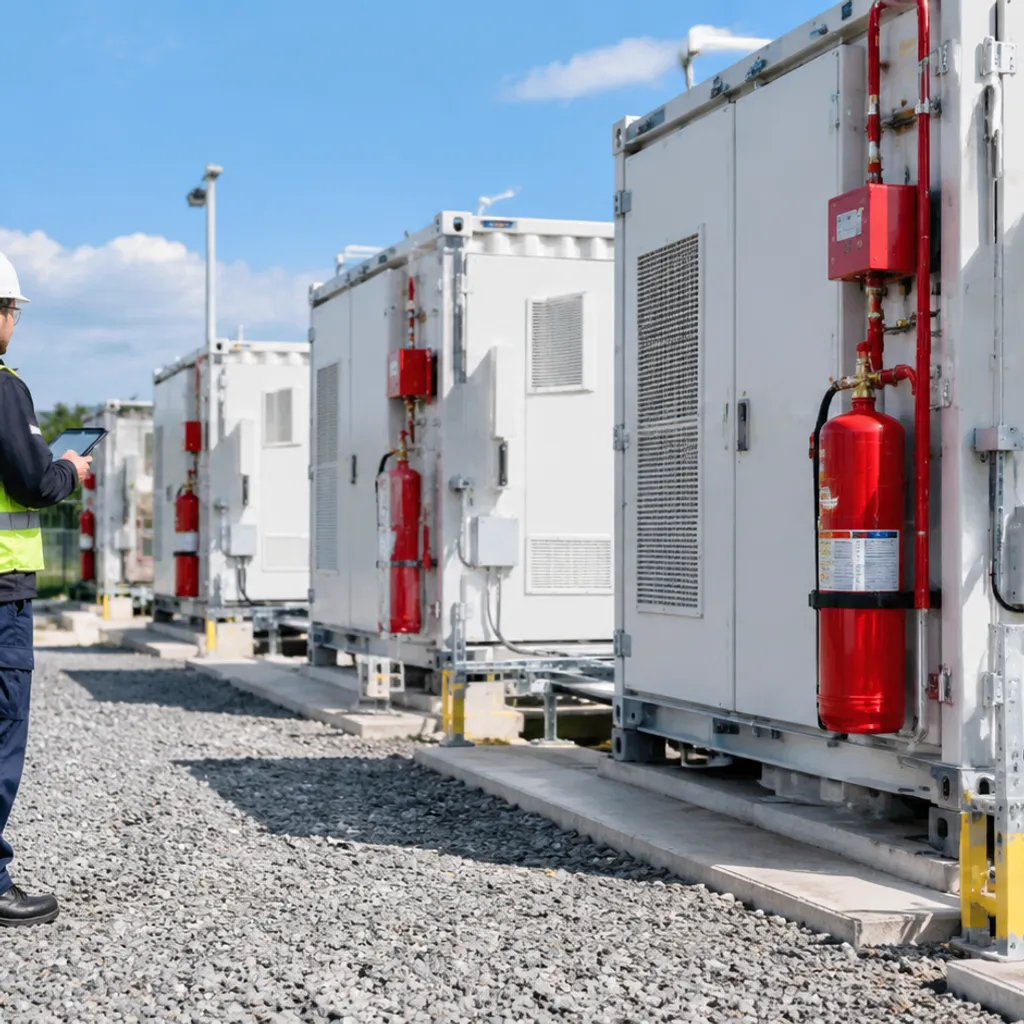
Early Off-Gas Detection and Multi-Layer Thermal Runaway Mitigation
Thermal runaway does not happen instantly; lithium-ion cells vent precursor gases well before temperature spikes or flames occur. Catching this venting phase early is the single most effective way to protect an industrial site.
- Pre-Venting Monitoring: We incorporate specialized battery storage fire detection systems with off-gas sensors to identify trace levels of hydrogen, carbon monoxide, and volatile organic compounds (VOCs).
- Cell-Level Isolation: Once off-gas is identified, the battery management system (BMS) automatically disconnects the affected module or rack, halting electrical current before thermal runaway propagates.
- Active Enclosure Exhaust: High-rate ventilation fans activate immediately upon off-gas detection to dilute gas concentrations and prevent explosive atmospheres from forming inside the container.
Navigating NFPA 855 Installation Standards and Clearance Rules
NFPA 855 dictates how stationary energy storage systems are sited, spaced, and isolated. For an industrial facility, meeting these clearance corridor rules prevents spatial conflicts with truck lanes, utility easements, and active loading docks.
- Unit Separation: Standard guidelines require up to 10 feet (3 meters) of clearance between individual outdoor enclosures and adjacent buildings.
- Clearance Reduction: When a container proves its fire containment capabilities under strict test conditions, AHJs typically approve reduced setbacks down to 3 feet, saving valuable facility footprint.
- Emergency Ingress: Dedicated access lanes must remain unobstructed for local fire departments, complete with external emergency-stop (E-Stop) interfaces and clear hazard signage.
UL 9540 and UL 9540A Testing Protocols for Industrial BESS
Achieving swift AHJ sign-off requires verified laboratory test data rather than theoretical safety claims.
- UL 9540 Certification: Confirms that the integrated battery pack, inverter, and thermal management architecture function safely as a complete, unified system.
- UL 9540A Test Methodology: Evaluates large-scale thermal runaway fire propagation at the cell, module, unit, and installation levels. The resulting test report determines whether fire can jump from one rack to another and quantifies heat release rates, deflagration hazards, and gas emissions.
Fire Suppression: Clean Agent Gas vs. Deluge Water Mist
Selecting the appropriate fire suppression strategy depends on your facility's environmental regulations, drainage infrastructure, and proximity to municipal water connections.
| Suppression Type | Primary Mechanism | Advantages for Industrial Plants | Trade-offs |
|---|---|---|---|
| Clean Agent Gas (Novec 1230 / FM-200) | Rapid heat absorption and chemical chain-reaction interruption | Leaves zero residue, prevents collateral electrical damage, rapid room dispersion | Effective only in sealed enclosures; does not cool surrounding cells after venting |
| Deluge Water Sprinkler / Mist | Direct surface cooling and oxygen displacement via steam | Prevents thermal runaway propagation to adjacent modules; removes residual heat | Requires water supply infrastructure and runoff collection/containment |
Our team typically deploys a hybrid safety design: clean agent gas provides initial flaming suppression inside closed rack compartments, backed by integrated dry-pipe water connections that allow municipal fire teams to cool the entire container if an external emergency demands it.
Industrial Microgrid Engineering: Integrating On-Site Energy Assets
Integrating a battery energy storage system (BESS) into an industrial facility turns disconnected equipment into a synchronized on-site microgrid. When production plants mix utility feeds, rooftop solar, diesel gensets, or steam turbines, our team focuses on eliminating power disruptions and fuel waste through coordinated asset balancing.
AC-Coupled vs. DC-Coupled Industrial Solar PV and Storage
Choosing the right hybridization architecture dictates efficiency, installation costs, and long-term expansion flexibility:
| Architecture | Best Fit For | Advantages | Trade-Offs |
|---|---|---|---|
| AC-Coupled | Retrofitting facilities with existing solar arrays | Simple installation; independent inverters; flexible equipment placement | Slightly lower round-trip efficiency due to DC-AC-DC conversion steps |
| DC-Coupled | New greenfield installations and tight footprints | Higher conversion efficiency; shared inverter hardware; lower balance-of-system cost | Dedicated engineering required; less flexible if expanding existing solar capacity |
For most brownfield industrial manufacturing plants, we deploy AC-coupled architectures. This allows plant engineers to add commercial BESS installations to operational rooftop or carport solar without altering verified photovoltaic warranties.
Optimizing Combined Heat and Power (CHP) and Backup Diesel Gensets
Legacy diesel generators and continuous CHP systems run inefficiently when forced to follow rapid swings in machine power demand. Introducing a battery energy storage system (BESS) to an industrial facility changes the operating profile:
- Dynamic Load Following: The battery absorbs immediate motor-starting spikes and punch-press surges, letting diesel generators run steadily at their optimal 75–85% fuel-efficiency sweet spot.
- Fuel and Maintenance Reduction: Eliminating wet-stacking and erratic cycling cuts annual fuel consumption and mechanical wear across heavy backup gensets.
- CHP Baseload Stabilization: Excess thermal-generation energy during low-demand shifts charges the battery instead of being flared or wasted.
Seamless Islanding Operations to Survive Grid Outages
Grid instability and unexpected utility blackouts can cause millions in ruined product batches and idle labor. To prevent manufacturing shutdowns, we implement an advanced grid-forming inverter battery energy storage system that establishes an independent reference voltage and frequency within milliseconds of a fault.
When the main utility line drops, high-speed static transfer switches disconnect the plant from the macro-grid. The storage system instantly carries the facility's critical electrical distribution boards without voltage sags, giving diesel generators sufficient time to spin up and sync cleanly without interrupting active production runs.
Step-by-Step Sizing and Implementation Guide for Plant Managers
Analyzing 15-Minute Load Profiling Interval Data for Power-to-Energy Sizing
Sizing behind-the-meter storage begins with raw interval data from utility smart meters or on-site power quality analyzers. We evaluate at least 12 consecutive months of 15-minute load profiling interval data—or 1-minute resolution data when heavy inductive equipment causes steep transient inrush spikes.
- Power Rating (kW/MW): Dictated by peak demand spikes above your targeted baseline. If your stamping presses or arc furnaces briefly elevate plant load by 1.5 MW over utility thresholds, the system's power conversion hardware must discharge rapidly to clip that demand.
- Energy Capacity (kWh/MWh): Dictated by the duration of those peak events. A spike lasting two hours requires a 1.5 MW / 3.0 MWh configuration (a 0.5C discharge rate).
- Load Characterization: We identify continuous baseload, cyclical spikes, and reactive power issues. For an in-depth breakdown of energy-to-power ratios and parameter checklists, consult our BESS sizing and selection guide.
| Sizing Parameter | Data Source | Primary Design Objective |
|---|---|---|
| Peak kW Threshold | 1-min to 15-min interval logs | Sets the inverter (PCS) continuous power rating |
| Discharge Duration (Hours) | Daily operational shift patterns | Determines total battery rack kWh capacity |
| Transient Inrush Currents | High-speed electrical logs | Verifies inverter surge capacity and response times |
Civil Footprint, Indoor vs. Outdoor ISO Container Placement, and Structural Loads
Positioning industrial battery energy storage systems requires balancing operational access with physical plant constraints. Most facilities deploy modular outdoor ISO containers, though indoor dedicated vault installations remain an option where yard space is unavailable.
- Outdoor ISO Enclosures: Placing prefabricated containers outside minimizes facility fire separation complications. We engineer reinforced, level concrete foundation pads rated for substantial structural loads—fully equipped 20-foot and 40-foot containers often exceed 30 to 40 metric tons.
- Clearance and Setbacks: Enclosures require dedicated clearance zones around doors, HVAC exhaust ports, and maintenance hatches. These corridors prevent thermal accumulation and give maintenance personnel unhindered service access.
- Indoor Vault Deployments: Installing equipment indoors requires high-capacity floor loading, dedicated HVAC ducting, robust fire separation barriers, and direct exterior venting routes to safeguard active production floors.
Navigating Utility Interconnection Agreements (IA) and Local AHJ Approvals
Interconnection and local compliance present the longest lead times in an industrial project. Our approach handles parallel workflows to keep utility engineers and local Authorities Having Jurisdiction (AHJ) aligned from day one.
- Utility Interconnection Agreement (IA): We submit detailed Single-Line Diagrams (SLD), three-phase short-circuit calculations, and protection coordination studies to the local distribution utility. The primary goal is demonstrating that backfeed prevention, anti-islanding schemes, and fault current contributions remain within local grid thresholds.
- AHJ and Fire Department Review: Local building and fire officials evaluate site plots against standard fire safety setbacks, structural anchoring calculations, and emergency disconnect accessibility.
- Hazard Mitigation Reviews: Presenting comprehensive emergency response plans and third-party safety certifications early in the process accelerates building permit approvals and avoids unexpected site redesigns during commissioning.
Lifecycle Cost Analysis: CapEx, OpEx, and Financial Modeling
Deploying a battery energy storage system (BESS) in an industrial facility requires a sharp look at long-term economics, not just the upfront price tag. We evaluate every installation through a complete lifecycle framework to calculate an accurate levelized cost of storage (LCOS) and secure maximum project returns.
Total Cost of Ownership: From Balance-of-Plant to Software
Upfront equipment costs are only part of the capital expenditure. A reliable commercial and industrial (C&I) BESS financial model covers several critical layers:
- Core Hardware & Balance-of-Plant (BoP): Battery enclosures, DC cabling, bidirectional power conversion systems (PCS), transformers, switchgear, and civil foundation pads.
- Site Engineering & Interconnection: Grid impact studies, permitting fees, local safety compliance, and utility physical interconnection works.
- Software Licensing & EMS: Cloud-based Energy Management System (EMS) licenses, firmware updates, cybersecurity protocols, and real-time SCADA integration.
- Operational Expenditures (OpEx): Scheduled thermal loop inspections, HVAC filter replacements, annual electrical testing, and performance monitoring.
| Cost Component | Typical Share of Project Budget | Key Drivers |
|---|---|---|
| Battery Modules & Enclosures | 45% – 55% | Cell quality, fire suppression, ingress protection |
| Inverters & Balance-of-Plant | 15% – 20% | Bi-directional PCS, transformers, switchgear |
| EPC, Civil Works & Permitting | 15% – 20% | Site prep, utility interconnection, local AHJ review |
| EMS & Long-Term Service (O&M) | 10% – 15% | Software tiers, routine maintenance, remote monitoring |
Managing Calendar vs. Cycle Degradation with Planned Augmentation
Battery cells inevitably lose capacity over time due to two distinct factors: calendar aging (chemical breakdown from ambient temperature and time) and cycle aging (throughput wear from active charging and discharging).
To avoid expensive oversizing on day one, we design behind-the-meter systems with a modular augmentation strategy. Instead of purchasing 100% of your projected year-ten capacity upfront, we install what your plant needs today and reserve physical footprint and electrical bus space. Our detailed LFP battery energy storage system guide explains how scheduled DC rack augmentation at year five to seven restores full operational headroom at significantly lower future cell costs.
Leveraging Tax Incentives, Accelerated Depreciation, and Rebates
Financial incentives significantly compress the payback window for an industrial BESS:
- Investment Tax Credit (ITC): Standalone energy storage systems qualify for federal clean energy tax credits, substantially offsetting initial capital expenditures.
- Modified Accelerated Cost Recovery System (MACRS): Qualifying industrial facilities can write off the depreciation of storage assets on an accelerated schedule, generating immediate tax relief.
- Utility Demand Response Rebates: Local grid operators and utilities provide direct performance payments and capacity rebates for plants that curtail peak loads using automated behind-the-meter assets.
Combining these incentives with consistent demand charge reduction allows an industrial facility to turn a major reliability asset into a self-funding operational upgrade.
Industrial Turnkey Solutions and Fleet Energy Management
Deploying a commercial and industrial (C&I) storage asset requires an integrated, fully engineered package built to withstand real-world plant conditions. We deliver end-to-end integration designed to streamline commissioning and guarantee long-term asset availability.
Modular Containerized BESS for Harsh Industrial Environments
Heavy manufacturing, chemical processing, and mining operations create extreme operational challenges, including dust, corrosive airborne chemicals, heavy vibration, and ambient thermal swings. To ensure maximum reliability for every battery energy storage system bess industrial facility deployment, we utilize pre-engineered, modular outdoor ISO enclosures.
- Rugged Enclosure Protection: Weatherproof, corrosion-resistant NEMA 3R/4X and IP55-rated enclosures shield battery racks, auxiliary equipment, and power conversion systems.
- Thermal Isolation: Multi-zone climate control and liquid-cooled battery racks maintain uniform cell temperatures, preventing hot spots and extending cycle life regardless of external weather.
- Scalable Footprint: Standardized container footprints allow flexible multi-megawatt scaling on tight industrial yards, keeping balance-of-system (BOS) civil work minimal.
Predictive Analytics for Automated Peak Dispatch and Tariff Tracking
Raw hardware requires smart controls to capture peak return on investment. Our systems integrate with an intelligent factory energy management solution for real-time monitoring that monitors plant bus loads continuously to automate demand charge reductions.
| Core Software Function | Operational Mechanism | Facility Impact |
|---|---|---|
| Dynamic Peak Shaving | Sub-second dispatch triggered by real-time plant load spikes | Caps 15-minute billing demand peaks automatically |
| Tariff Arbitrage Engine | Algorithmic charging during off-peak hours and discharging during high-rate windows | Minimizes overall volumetric utility charges |
| Health Monitoring | Continuous cell-level impedance and degradation analytics | Mitigates thermal risks and maximizes rack longevity |
Full-Lifecycle Engineering Support: Site Audit to Long-Term O&M
Handling complex behind-the-meter storage requires a single point of accountability. As a dedicated bess company for utility-scale turnkey storage systems, our engineering team manages the complete lifecycle to eliminate operational downtime:
- Site Assessment & Interval Load Profiling: We analyze your historical 15-minute utility billing data and facility power factors to right-size battery capacity and inverter output.
- Turnkey EPC & Permitting: We manage electrical interconnection approvals, local fire department consultations, structural pad design, and utility grid compliance.
- Preventive O&M and Augmentation: Our field engineers provide 24/7 remote operations, scheduled preventative maintenance, warranty verification, and timed cell rack augmentations to offset natural degradation over the system's 15- to 20-year lifespan.
Frequently Asked Questions About Industrial Facility BESS
Deploying a battery energy storage system bess industrial facility setup brings up practical questions about payback, footprint, safety clearances, and existing infrastructure compatibility. Here are direct answers to the most common questions plant operators ask our team.
What is the typical payback period for an industrial BESS project?
Most industrial installations break even within 3 to 7 years. The exact return timeline depends on three main variables:
- Demand Charge Structure: Heavy 15-minute peak tariff fees yield the fastest demand charge reduction returns.
- Energy Arbitrage Spreads: High spreads between off-peak charging and on-peak discharging accelerate savings.
- Incentives and Rebates: Federal investment tax credits (ITC), regional grants, and accelerated depreciation (MACRS) significantly reduce initial balance-of-plant costs.
| Facility Type | Average Peak Demand | Key Value Driver | Typical Payback |
|---|---|---|---|
| Plastics & Injection Molding | 1.5 MW – 3.0 MW | Peak shaving & scrap prevention | 3.5 – 5 Years |
| Cold Storage & Logistics | 800 kW – 2.0 MW | Time-of-use (TOU) arbitrage | 4 – 6 Years |
| Heavy Manufacturing | 2.5 MW – 10.0+ MW | Demand charges & microgrid backup | 4 – 7 Years |
Reviewing standard commercial & industrial energy storage systems helps clarify which capacity profiles match specific operational profiles.
How much physical footprint does an industrial battery container require?
Industrial systems are modular and typically built into standard ISO shipping container footprints (10-ft, 20-ft, or 40-ft enclosures).
- 20-foot container: Holds up to 2.5 MWh–3.7 MWh with direct liquid-cooled lithium iron phosphate (LFP) racks, measuring roughly 6.06 m × 2.44 m (20 ft × 8 ft).
- Clearance buffers: Under NFPA 855 guidelines, outdoor enclosures generally require a 3-meter (10-foot) separation distance from outer facility walls, property lines, and combustible structures unless full-scale fire testing permits closer placement.
You can check complete dimensions and spacing requirements in our battery energy storage system BESS container specifications.
Can an industrial BESS fully replace a facility diesel backup generator?
A standalone BESS can replace diesel gensets for short-to-medium durations, but long-duration outages usually call for a hybrid setup.
- Where BESS wins: A BESS offers sub-second, seamless power transfer without voltage sags, zero on-site emissions, silent operation, and ongoing revenue via peak shaving while idle.
- Where generators are needed: If your facility faces potential grid outages lasting 24 to 72 hours, an oversized battery bank may be cost-prohibitive.
- The ideal solution: Pair your existing generator with a BESS. The battery handles instant bridging and short blips, while the generator handles prolonged outages without requiring massive battery over-sizing.
How do we determine whether to choose indoor or outdoor containerized storage?
Outdoor containerized installations are standard for industrial facilities due to safety and permitting considerations, though indoor switchgear rooms are occasionally viable.
- Outdoor Containers: The easiest path to compliance. They simplify compliance with NFPA 855 clearance corridors, make delivery and crane placement straightforward, and isolate fire risks outside the main operating envelope.
- Indoor Battery Rooms: Practical only when outdoor yard space is unavailable. Indoor setups require specialized fire-rated enclosures, dedicated spill containment, and heavy-duty HVAC, which substantially increases civil engineering costs.