Formula details
Product Details
Overview
What Is a 2MWh Solar Battery Energy Storage System?
A 2MWh solar battery energy storage system delivers 2,000 kilowatt-hours (kWh) of usable electrical energy in a single, factory-integrated enclosure. Designed for commercial, industrial (C&I), and front-of-the-meter utility applications, this platform buffers intermittent solar generation, eliminates steep peak-demand charges, and supplies continuous backup power during grid outages.
Core Technical Specifications and Capacity Breakdown
A standard 2MWh configuration integrates high-density battery racks, power conversion hardware, and intelligent thermal management into an all-in-one footprint.
| Parameter | Specification (Standard 2-Hour System) | Specification (Standard 4-Hour System) |
|---|---|---|
| Nominal Energy Capacity | 2,000 kWh (2.0 MWh) | 2,000 kWh (2.0 MWh) |
| Continuous Power Output | 1,000 kW (1.0 MW) | 500 kW (0.5 MW) |
| Nominal C-Rate | 0.5C | 0.25C |
| Battery Chemistry | Lithium Iron Phosphate (LiFePO4 / LFP) | Lithium Iron Phosphate (LiFePO4 / LFP) |
| DC Operating Voltage Range | 800V – 1500V DC | 800V – 1500V DC |
| Round-Trip Efficiency (AC-AC) | 88% – 92% | 89% – 93% |
| Enclosure Footprint | Standard 20ft High-Cube ISO Container | Standard 20ft High-Cube ISO Container |
| Expected Cycle Life | ≥ 6,000 cycles @ 80% DoD, 25°C | ≥ 6,000 cycles @ 80% DoD, 25°C |
Containerized Utility and C&I Modular Design
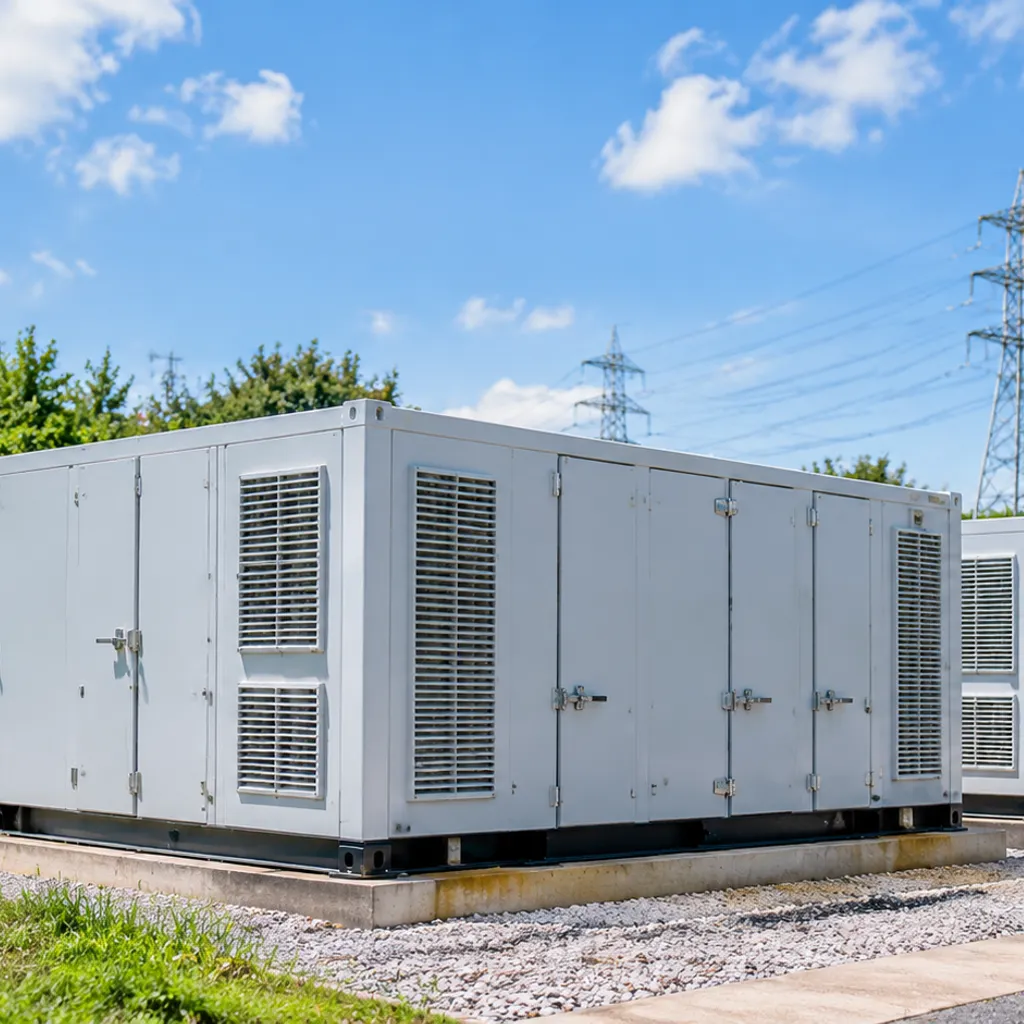
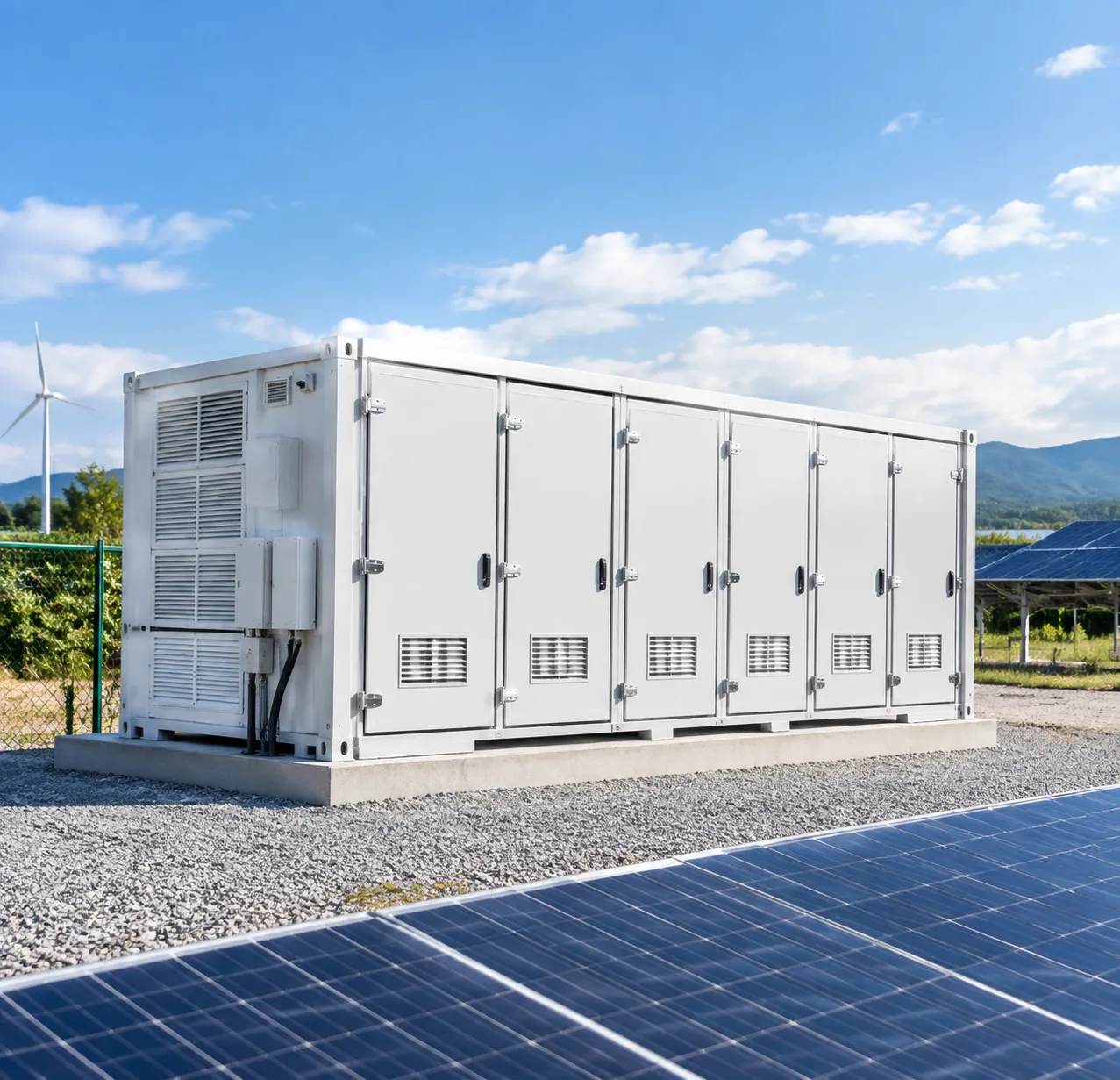
We package our 2MWh BESS units inside standardized 20ft high-cube ISO shipping containers. This modular, plug-and-play architecture drastically cuts onsite civil engineering and installation labor.
- Factory-Preassembled: Battery modules, wiring harnesses, thermal control, and fire suppression systems are pre-installed and pre-commissioned before transport.
- Scalable Footprint: Units can be paralleled to scale capacity effortlessly from 2MWh to 10MWh, 50MWh, or 100MWh+ multi-container utility farms.
- Rapid Interconnection: Minimal external field wiring is needed—connect the DC or AC bus, communication lines, and auxiliary power feeds directly to the terminal compartments.
LiFePO4 (LFP) Chemistry Advantages for Large-Scale Storage
Large-scale energy storage demands maximum safety, thermal tolerance, and cost efficiency. We exclusively utilize Lithium Iron Phosphate (LiFePO4) chemistry across our commercial and industrial BESS platforms.
- Superior Thermal Stability: LFP cells tolerate higher thermal thresholds before onset degradation and will not release oxygen during high-heat events, preventing thermal runaway propagation.
- Extended Service Life: Delivers over 6,000 to 8,000 full charge-discharge cycles while retaining at least 70% to 80% of original capacity.
- Lower Levelized Cost of Storage (LCOS): Non-toxic, cobalt-free, and nickel-free materials make LFP more sustainable and significantly cheaper to operate and insure over a 15-to-20-year project lifespan.
AC-Coupled vs. DC-Coupled Solar Integration Architectures
Choosing the right electrical architecture dictates project efficiency, inverter hardware costs, and installation complexity.
AC-Coupled Architecture
[ Solar PV ] → [ PV Inverter ] → [ AC Bus ] → [ Facility Loads / Grid ]
[ 2 MWh BESS ] ↔ [ Bidirectional PCS ] ↔ [ AC Bus ]
DC-Coupled Architecture
[ Solar PV ] → [ MPPT DC/DC ] → [ DC Bus ] → [ Shared Inverter / PCS ] → [ Facility / Grid ]
[ 2 MWh BESS ] ↔ [ DC Bus ]
- AC-Coupled Integration:
- Best for: Retrofitting existing commercial solar arrays or multi-source microgrids.
- Advantages: Operates independently from the existing PV inverter; simpler system expansion and utility compliance.
- DC-Coupled Integration:
- Best for: New ground-mount or commercial rooftop installations designed simultaneously.
- Advantages: Direct DC-to-DC charging minimizes conversion stages, capturing high-yield solar clipping energy with higher overall system efficiency.
Round-Trip Efficiency (RTE) and Standard C-Rate Options
We configure charge and discharge durations using standard application-specific C-rates:
- 1C (1-Hour Duration / 2MW Output): Fast-response power application for primary frequency regulation, critical microgrid surge handling, and fast ramp-rate control.
- 0.5C (2-Hour Duration / 1MW Output): Standard commercial profile optimized for daily peak shaving, time-of-use (TOU) arbitrage, and evening peak reduction.
- 0.25C (4-Hour Duration / 500kW Output): Ideal for utility capacity firming, prolonged solar shifting, and sustained facility backup during prolonged outages.
Inside a 2MWh Solar Battery Energy Storage System
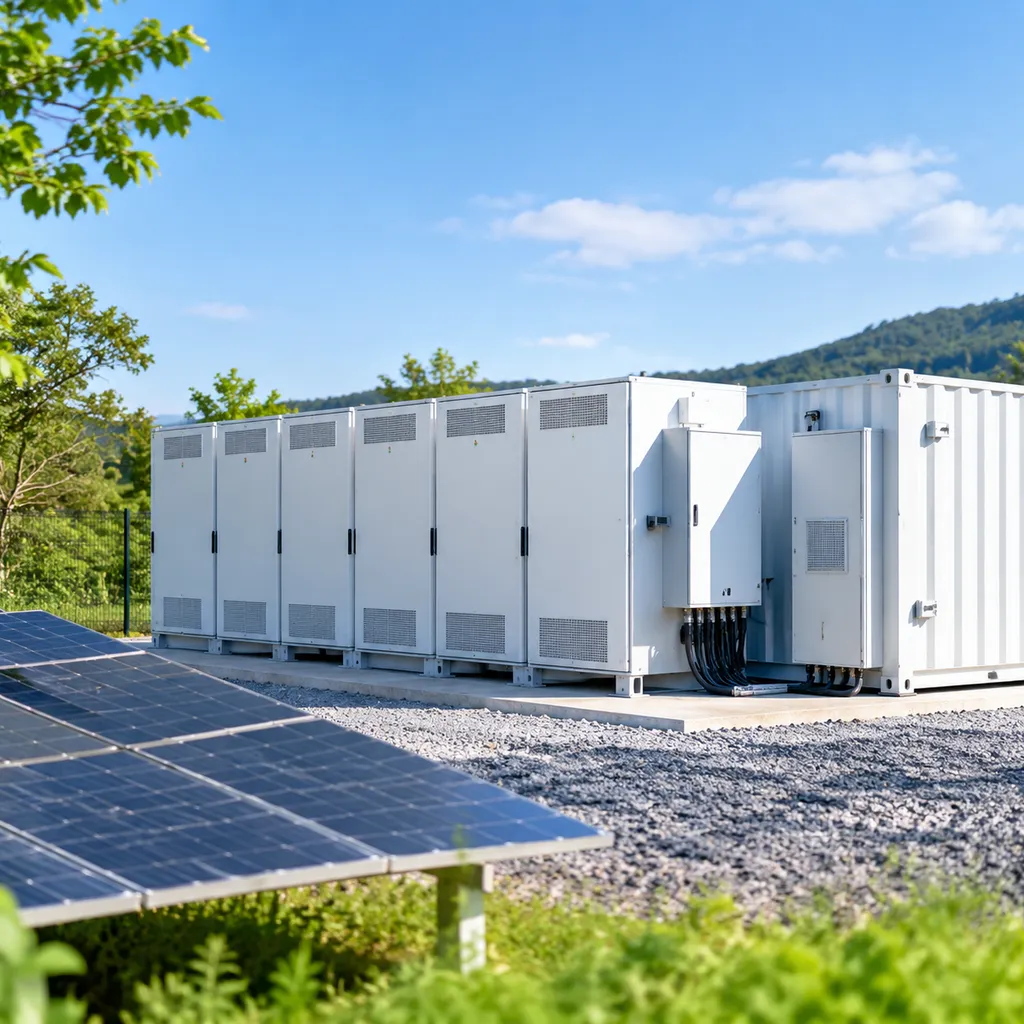
High-Density Battery Modules and Rack Architecture
The core of our containerized battery energy storage system uses high-density Lithium Iron Phosphate (LiFePO4) cell racks. We build these systems using standardized modules wired in series and parallel to reach the target voltage and capacity.
- Cell Chemistry: Long-life LiFePO4 (LFP) prismatic cells.
- Rack Setup: Multi-tier rack designs with slide-in module architecture for easy maintenance.
- DC Bus Aggregation: High-voltage DC combiner boxes with individual rack disconnects and overcurrent protection.
Bidirectional Power Conversion System (PCS)
The bidirectional Power Conversion System (PCS) serves as the high-efficiency bridge between your solar array, the battery banks, and the AC grid.
- Four-quadrant active and reactive power control (P-Q management).
- Sub-cycle millisecond response times for seamless grid-tied and islanded operations.
- Modular multi-MPPT inverter integration for streamlined DC- or AC-coupled commercial solar.
Multi-Tier BMS and Intelligent EMS Architecture
System safety and automated optimization run on a layered control setup. Evaluating these operational layers helps operators weigh the system dynamics outlined in our breakdown of battery energy storage system advantages and disadvantages.
| Control Layer | Primary Function | Key Features |
|---|---|---|
| BMU (Unit Level) | Cell monitoring | Real-time cell voltage, temperature sampling, and passive/active balancing. |
| RBMS (Rack Level) | Rack protection | String voltage/current monitoring, state-of-charge (SOC), and contactor control. |
| SBMS (System Level) | System aggregation | Master DC bus coordination, insulation detection, and PCS communication. |
| EMS (Facility Level) | Automated dispatch | Peak shaving algorithms, time-of-use (TOU) arbitrage, and remote SCADA monitoring. |
Thermal Management: Smart Liquid Cooling vs. Forced Air
Maintaining uniform cell temperatures is critical for mitigating battery degradation and extending cycle life.
[ Liquid Cooling Loop ] → Uniform Core Heat Dissipation (ΔT ≤ 3°C) → Up to 20% Longer Cell Life
[ Forced Air Cooling ] → Ambient-Dependent Convection (ΔT ≤ 8°C) → Higher Parasitic Load
Our advanced liquid cooled battery container circulates dedicated glycol-water coolant plates directly across the base of each cell module. This keeps the temperature variance across the entire 2MWh pack within 3°C, cutting parasitic HVAC power losses by up to 30% compared to traditional forced-air setups.
Integrated Fire Protection and Safety Units
Safety is engineered directly into the hardware layers to prevent cascading thermal events:
- Early Detection: Multi-sensor arrays monitoring off-gas (hydrogen and CO), smoke, and rapid temperature spikes.
- Fire Suppression: Total-flooding clean agent systems (such as Novec 1230 / FK-5-1-12) backed by direct-injection water deluge interfaces.
- Explosion Mitigation: NFPA 68/69 compliant passive explosion relief panels located on the container roof.
- Safety Standards: Designed strictly to meet UL 9540A thermal runaway standard testing requirements.
Commercial and Industrial Use Cases for 2MWh Battery Storage
| Commercial Application | Primary Business Benefit |
|---|---|
| Peak Shaving | Slashes utility demand charges during peak hours |
| Solar Energy Time-Shifting | Stores daytime solar for night-shift consumption |
| Resilient Microgrid Backup | Keeps critical operations running during blackouts |
| Grid Ancillary Services | Earns revenue via frequency and voltage balancing |
| High-Power EV Fleet Charging | Buffers high-kW spikes without utility upgrades |
Peak Shaving and Industrial Demand Charge Reduction
Utility tariffs penalize commercial facilities heavily for brief, intense spikes in power consumption.
Targeted discharge: Our system automatically detects when site demand reaches peak thresholds and discharges stored power instantly.
Cost suppression: By flattening these spikes, a peak shaving energy storage strategy eliminates up to 30% to 70% of monthly demand charges.
Seamless transition: The system reacts in milliseconds, ensuring your operations never trigger expensive utility penalty brackets.
Solar Energy Time-Shifting for 24/7 Self-Consumption
Generating excess solar during midday often leads to cheap grid export or wasted curtailment.
Energy capture: A C&I battery energy storage system stores every surplus kilowatt-hour produced by your rooftop or ground-mount PV array.
Off-peak discharge: We dispatch that stored green power during high-rate evening hours or overnight shifts.
Maximized ROI: This maximizes self-consumption, shielding your facility from fluctuating retail electricity tariffs.
Microgrid Support and Resilient Emergency Backup Power
Grid outages halt production lines, spoil inventory, and cost thousands per minute.
Islanded operation: Paired with on-site generation, our 2MWh setup functions as a robust microgrid battery backup, instantly isolating your facility from a failed grid.
Continuous runtime: It supplies reliable, stable electricity to critical loads, cold storage, and manufacturing processes without the downtime associated with traditional diesel generator spin-up.
Grid Stabilization Services: Frequency Regulation and Voltage Support
For facilities operating in deregulated energy markets, battery assets generate direct revenue through ancillary grid programs. Using utility-scale battery storage containers for solar and wind, we enable rapid bidirectional power injection to stabilize local grid frequency and regulate voltage, allowing asset owners to participate in capacity markets and demand-response programs.
EV Fleet Charging Infrastructure Demand Management
Electrifying commercial delivery fleets, buses, or heavy machinery introduces massive instantaneous power draws.
Grid buffer: Installing multiple DC fast chargers often exceeds local transformer capacities.
Infrastructure savings: A 2MWh commercial solar plus storage installation acts as a high-output energy reservoir, charging vehicles rapidly without requiring costly, time-consuming utility substation upgrades.
2MWh Solar BESS Sizing, Footprint, and Site Integration
Sizing the Optimal Solar PV Array for 2MWh Storage
A balanced commercial solar energy storage solution ensures the PV system generates enough excess energy during peak sun hours to fully charge the battery without excessive curtailment.
To determine the right PV capacity for a 2MWh battery:
Target Daily Charge Energy: A 2MWh system with a 90% Depth of Discharge (DoD) and 88% round-trip efficiency (RTE) needs approximately 2.05 MWh to 2.15 MWh of dedicated generation daily.
Peak Sun Hours (PSH): Across standard global regions averaging 4.0 to 5.0 PSH per day, we recommend pairing a 2MWh storage block with a 1.5 MWp to 2.5 MWp solar PV array.
Load Profile Alignment: If your facility consumes power heavily during the day, we increase the PV array size to cover concurrent operational loads while routing surplus DC power to storage. For deeper sizing calculations, review our comprehensive BESS sizing and selection guide.
Container Form Factors: 20ft vs. 40ft High-Cube Footprints
We package our utility-scale and industrial systems into standard ISO high-cube shipping containers, optimized for rapid transport and plug-and-play field installation.
| Specification | 20ft High-Cube Container | 40ft High-Cube Container |
|---|---|---|
| Dimensions (L x W x H) | 6.06 m x 2.44 m x 2.89 m (20' x 8' x 9'6") | 12.19 m x 2.44 m x 2.89 m (40' x 8' x 9'6") |
| Energy Density | Ultra-high density (Liquid-cooled LFP) | High density (Integrated PCS & transformer space) |
| Gross Weight (Fully Loaded) | ~28 to 32 metric tons | ~38 to 45 metric tons |
| Best Suited For | Space-constrained C&I and microgrid sites | All-in-one centralized solar-plus-storage plants |
For turnkey utility-grade deployments with integrated power conversion, our pre-engineered 40ft 1MW/2MWh battery energy storage container delivers a self-contained power plant footprint.
Site Layout & Clearance Envelope
[ 3.0 m / 10 ft Buffer: Local Fire Code / NFPA 855 ]
↓
[ 2 MWh Battery Storage Container (ISO HC) ]
← 1.5 m Door Swing Clearance | 1.5 m Maintenance Clearance →
- Liquid Cooling Chiller (External End)
- Inverter / PCS Skid Section
↓
[ Foundation Pad ]
↓
[ Heavy Crane Access & Step-Up Transformer Bay ]
Site Foundation and Civil Engineering Requirements
Civil engineering mistakes cause settling, cable strain, and thermal management failures. We mandate strict site prep before dropping the container:
- Reinforced Concrete Pad: Poured concrete slab designed for a minimum 3,000 to 4,000 PSI rating, engineered to support 35–50 tons of concentrated live and dead loads.
- Seismic and Wind Anchoring: Mechanical anchor bolts matched to local seismic zones (IBC Seismic Design Categories C through E) and wind ratings up to 140 mph (225 km/h).
- Clearance Distances: Maintain a minimum 3.0-meter (10 ft) separation from property lines, exterior combustible walls, and adjacent BESS units to comply with NFPA 855 separation mandates. Maintain 1.5 meters of perimeter space for door swing and routine maintenance access.
- Drainage and Conduit Stubs: Pre-cast trenching or PVC conduit stubs set beneath the PCS termination bay for DC cabling, AC bus lines, and fiber-optic communication lines, elevated above the local 100-year flood zone level.
Transformer Matching and Medium-Voltage Grid Interconnection
Connecting a 2MWh battery container to local distribution networks requires robust medium-voltage (MV) engineering:
- Inverter-to-Transformer Matching: We connect the 2MWh battery through a bidirectional PCS (typically 500 kW to 1,000 kW output) operating at low AC voltages (400V, 480V, or 690V).
- Step-Up Transformer Skid: A dedicated oil-immersed or cast-resin step-up transformer steps the low-voltage inverter output up to utility distribution levels (11 kV, 13.8 kV, 22 kV, 33 kV, or 34.5 kV).
- Switchgear and Interconnection Protections: The point of common coupling (PCC) includes vacuum circuit breakers (VCB), visible disconnects, surge arresters, and utility-grade protection relays configured for IEEE 1547-2018 and UL 1741-SB compliance.
- Fault Current and Anti-Islanding: Integrated sync-check relays and rapid anti-islanding ensure safe automatic tripping during grid dropouts or seamless transfer to islanded microgrid operations.
Cost Breakdown, ROI, and Revenue Generation for a 2MWh Solar Battery Energy Storage System
Investing in a 2mwh solar battery energy storage system comes down to one core question: how quickly does the asset pay for itself while generating positive cash flow? Evaluating capital costs, tax write-offs, operational overhead, and layered revenue streams gives a transparent look at the numbers.
CapEx vs. OpEx Breakdown
Total turnkey costs for a commercial lithium storage project split into upfront installation and ongoing operational management:
| Cost Component | Typical Share of CapEx | Key Cost Drivers |
|---|---|---|
| Battery Racks & Enclosure | 45% – 55% | LiFePO4 cells, rack structure, liquid cooling loops, fire suppression |
| Power Conversion System (PCS) | 10% – 15% | Bidirectional inverters, isolation transformers, switchgear |
| Balance of Plant & EPC | 20% – 25% | Site civil works, concrete pad, medium-voltage trenching, permits |
| Interconnection & Soft Costs | 10% – 15% | Utility interconnection study, engineering stamps, commissioning |
- Ongoing OpEx: Annual operations and maintenance (O&M) generally runs between 1.5% and 2.5% of initial CapEx. This covers scheduled liquid coolant checks, HVAC filter replacements, remote software diagnostics, and insurance. Reviewing a comprehensive LFP battery energy storage system cost and lifespan guide helps project multi-year maintenance budgets accurately.
Tax Credits, Depreciation, and Incentives
Financial incentives significantly lower upfront capital requirements:
- Investment Tax Credit (ITC): Qualifies for a baseline 30% federal tax credit under standalone or solar-coupled deployments, with potential 10% adders for domestic content or energy community zones.
- Modified Accelerated Cost Recovery System (MACRS): Allows businesses to depreciate the asset value over a 5-year accelerated schedule, often offsetting up to 20–25% of the total system cost within the first two operating years.
- Regional Grants & SRECs: Local grid operator programs and state-level storage mandates provide upfront cash rebates and performance-based renewable certificates.
Levelized Cost of Storage (LCOS) and Revenue Stacking
A reliable Levelized Cost of Storage (LCOS) for utility-scale and industrial LFP containers typically ranges from $0.07 to $0.13 per kWh throughput, depending on cycle depth and local ambient conditions.
To maximize asset yield, we stack multiple revenue streams simultaneously:
- Demand Charge Management: Capping 15-minute facility peak surges during high-tariff operational hours.
- Energy Arbitrage: Charging the system with cheap off-peak solar generation and discharging during peak utility pricing.
- Grid Ancillary Programs: Enrolling available capacity into automated demand response, frequency regulation, and reserve capacity markets.
Evaluating the direct benefits of peak shaving for lower energy costs reveals how consistent load clipping produces immediate utility bill reductions without interrupting daily plant operations.
Typical Payback Periods Across Commercial Load Profiles
- Heavy Manufacturing (24/7 Operations): 3 to 5 years. High demand charges and constant multi-shift energy use provide continuous cycling opportunities.
- Cold Storage & Distribution Centers: 4 to 6 years. Consistent refrigeration baselines allow predictable daytime solar peak shaving and overnight off-peak charging.
- Commercial Campuses & EV Fleet Hubs: 5 to 7 years. Solar time-shifting combined with fleet charging demand mitigation ensures reliable, predictable cash flow returns.
Safety Standards, Certifications, and Environmental Protections for a 2MWh Solar Battery Energy Storage System
UL 9540 and UL 9540A Thermal Runaway Safety Compliance
Fire safety starts at the cell level and extends across the entire system. Our containerized units undergo full-scale fire testing to eliminate cascade risks.
- UL 9540 Certification: Validates the entire integrated system, including the battery packs, inverter, thermal controls, and safety subsystems as a singular, secure unit.
- UL 9540A Test Method: Evaluates large-scale thermal runaway fire propagation. Test data confirms that internal cell failures remain isolated without propagating to adjacent modules or racking sections.
NFPA 855 Installation Standards and Local Fire Code Compliance
Meeting local zoning and fire department requirements is critical to avoid project delays. We align our system architecture directly with international fire protection mandates:
- NFPA 855 Standard: Dictates safe unit spacing, maximum allowable energy densities, and required setback distances from property lines and occupied structures.
- Integrated Safety Systems: Equipped with multi-point gas detection, early-warning smoke sensors, automated aerosol/water-deluge suppression, and mechanical deflagration explosion panels to comply with NFPA 68/69 guidelines.
NEMA 3R / IP55-Rated Enclosures for Harsh Outdoor Environments
Outdoor commercial solar plus storage assets must endure extreme weather conditions without performance loss. We package high-density storage using ruggedized enclosures such as an outdoor battery energy storage system with LiFePO4 battery setup engineered for long operational life.
| Environmental Metric | Specification Standard | Operational Benefit |
|---|---|---|
| Ingress Protection | IP55 / NEMA 3R | Blocks wind-blown dust, rain, sleet, and external debris |
| Corrosion Resistance | C4/C5 Marine-Grade Coating | Resists salt-fog, industrial pollution, and high humidity |
| Operating Ambient Range | -30°C to +55°C | Liquid thermal loop maintains cell core at optimal 25°C |
End-of-Life Battery Recycling and Environmental Impact Management
Responsible lifecycle management ensures minimal environmental footprint and preserves critical materials:
- Sustainable Disposal: Closed-loop recycling programs recover over 95% of active materials, including lithium, iron phosphate, copper, and aluminum.
- Secondary Life Integration: Where applicable, decommissioned packs can be repurposed for lower-intensity grid balancing before final smelting and hydrometallurgical recycling.
- RoHS & REACH Compliant: Battery modules are manufactured without hazardous heavy metals like lead, mercury, or cadmium.
Frequently Asked Questions About 2MWh Solar Battery Systems
How much physical space does a 2MWh containerized BESS require?
A standard 2MWh solar battery energy storage system fits inside a single 20-foot high-cube ISO shipping container. The outer footprint measures roughly 20 ft x 8 ft x 9.5 ft (6.06 m x 2.44 m x 2.89 m).
When preparing the site layout, factor in minimum setback distances mandated by local fire regulations and NFPA 855 standards:
Clearance: Maintain 3 to 10 feet (1 to 3 meters) of perimeter clearance around the unit for ventilation, door swings, and maintenance access.
Pad Requirements: A reinforced, level concrete foundation engineered to support an operating weight of 25 to 32 metric tons.
For complete dimensions, foundation requirements, and weight breakdowns, check our battery energy storage system container specifications.
How many hours can a 2MWh battery power a medium-to-large facility?
Runtime depends directly on the facility’s active electrical load and the system's discharge rate (C-rate):
| Continuous Facility Load | Discharge Rate (C-rate) | Usable Backup / Operating Time |
|---|---|---|
| 1,000 kW (1 MW) | 0.5C | ~1.8 to 2.0 Hours |
| 500 kW | 0.25C | ~3.8 to 4.0 Hours |
| 250 kW | 0.125C | ~7.5 to 8.0 Hours |
| 100 kW | 0.05C | ~18.0 to 20.0 Hours |
For most commercial peak-shaving operations, the system injects high power during peak billing windows (typically 2 to 4 hours daily) rather than running continuously down to zero.
What is the expected lifespan and annual degradation rate of an LFP 2MWh system?
Modern utility-grade systems built with lithium iron phosphate cells deliver dependable long-term performance:
Operating Lifespan: 15 to 20 years under standard commercial cycling profiles.
Cycle Life: 6,000 to 8,000+ full cycles at 80% Depth of Discharge (DoD) to 70% End-of-Life (EoL) capacity.
Annual Capacity Degradation: Roughly 1.5% to 2.2% per year under active thermal regulation.
Partnering directly with a certified LiFePO4 BESS manufacturer ensures tier-1 cell matching, precise multi-tier BMS tracking, and enforceable multi-year capacity warranties.
How does liquid cooling improve 2MWh battery performance over air cooling?
Liquid thermal management circulates a dedicated coolant loop directly across the battery module cold plates:
Uniform Temperature Control: Keeps cell-to-cell thermal variations within ≤ 2°C to 3°C, compared to 5°C to 8°C variations seen in forced-air systems.
Lower Parasitic Draw: Reduces auxiliary HVAC power consumption by 20% to 30%, raising overall round-trip efficiency (RTE).
Extended Cell Health: Eliminates hot spots that accelerate local degradation, adding years to module operational life.
Higher Energy Density: Enables tightly packed rack designs within a smaller 20ft enclosure.
What grid interconnection permits are required before deploying a 2MWh BESS?
Deploying a commercial or utility-scale 2MWh BESS requires standard regulatory approvals:
1. Utility Interconnection Agreement: Formal impact study and sign-off ensuring compliance with IEEE 1547 and local utility Rule 21 standards.
2. Authority Having Jurisdiction (AHJ) Fire Approval: Hazard Mitigation Analysis (HMA) review verified against UL 9540 and NFPA 855 fire safety codes.
3. Local Building and Electrical Permits: Structural pad engineering, high-voltage conduit routing, and grounding safety checks.
4. Environmental and Zoning Approvals: Site noise verification, environmental runoff compliance, and local land-use zoning clearances.